Clinic Support Assistant
The flow
Overview
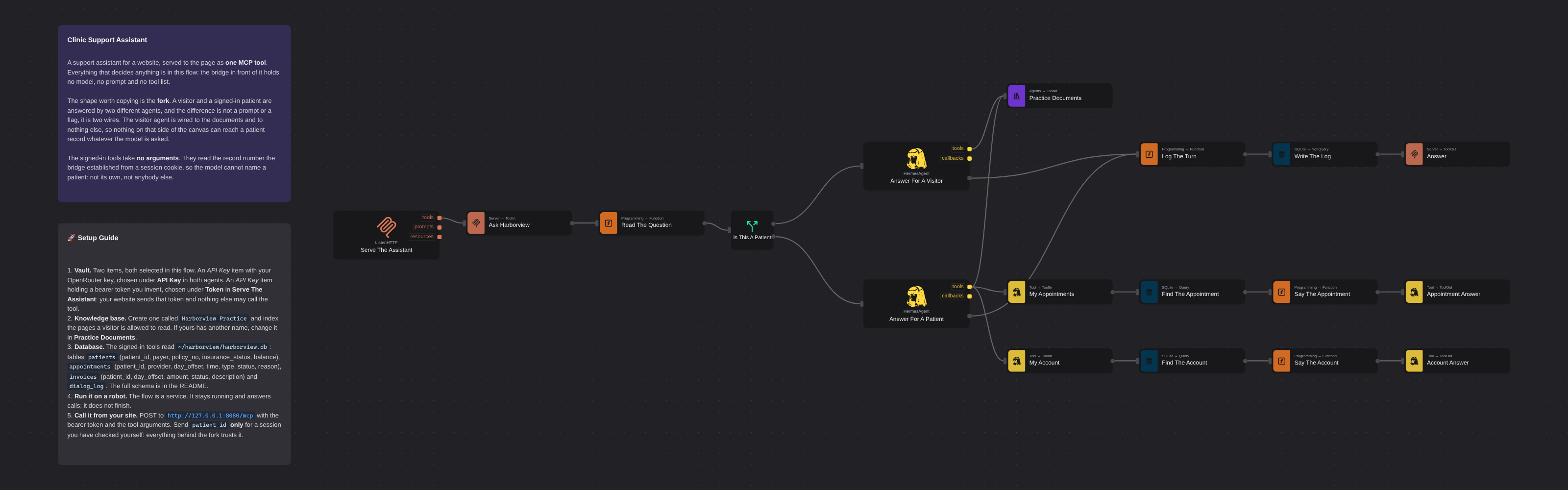
A customer support assistant for a website, served to the page as one MCP tool. A visitor and a signed-in patient are answered by two different Hermes Agents, and the difference is not a prompt or a flag, it is two wires: the visitor's agent is wired to the practice documents and to nothing else, so nothing on that side of the canvas can reach a patient record whatever the model is asked. The signed-in tools take no arguments at all. They read the record number the website established from a session cookie, so the model cannot name a patient, and every turn is written to a dialog log the practice can read in the morning.
Clinic Support Assistant
Clinic Support Assistant answers questions on a company's website: from the public documents for anyone who turns up, and from the customer's own record once they have signed in. It is worked here as a family practice, but the shape is any support desk.
The whole assistant is served to the page as one MCP tool. The bridge in front of it holds no model, no prompt and no tool list, so what the assistant is allowed to do is this canvas and nothing else.
The part worth copying is the fork. A visitor and a signed-in patient are answered by two different Hermes Agents, and the difference between them is not a prompt or a flag, it is two wires. The visitor's agent is wired to the practice documents and to nothing else, so there is no tool on that side of the canvas that could read a patient's record, whatever the model is asked to do.
What Clinic Support Assistant can do
- Answer a stranger's question from your own documents, and say so plainly when they do not cover it
- Answer a signed-in customer's question about their own appointment and account
- Keep the two apart by wiring rather than by instructions, so a prompt injection has nothing to reach for
- Hold a conversation per session, and a separate one for a signed-in customer on a shared computer
- Write every turn to a dialog log: the question, the answer, which tools ran, and how long it took
Behind the scenes
Listen HTTP makes the flow a stateless MCP server on 127.0.0.1:8080/mcp, guarded by a bearer token from the Vault. One Tool In declares ask_harborview with three arguments: the question, a session id, and a patient_id that only the website may set.
Read The Question takes them off the message and does the one check that matters: a record number is accepted only if it looks like one, and the conversation id is bound to the patient so a shared computer cannot inherit the last person's thread. Is This A Patient is an ordinary Switch, and its two ports are the fence.
Each branch is a Hermes Agent with its own system prompt. Both are wired to the same Knowledge Base Toolkit, because what a visitor may read and what a patient may read are the same pages of the same website. Only the patient's agent is also wired to My Appointments and My Account.
Those two tools declare no arguments at all. Their JSON schema is an empty properties object, and the SQL behind them reads {{{patient_id}}} off the message the agent was called with. A tool that cannot be told who to look up cannot be talked into looking up somebody else.
Both agents' ordinary output goes to Log The Turn, which works out which tools actually ran by reading the agent's own message history, drops anything that branch was never given, escapes the text for SQL, and hands the answer back through Tool Out.
Setup Guide
- Vault: create an API Key item with your OpenRouter key and select it under API Key in both agent nodes. Create a second item holding a bearer token of your own invention and select it under Token in Serve The Assistant. Your website sends that token; nothing else may call the tool.
- Knowledge base: create one called
Harborview Practiceand index the pages a visitor is allowed to read. If yours has another name, change it in Practice Documents. - Database: the two signed-in tools read
~/harborview/harborview.db. Create it with:
CREATE TABLE patients (
  patient_id       TEXT PRIMARY KEY,
  name             TEXT NOT NULL,
  email            TEXT NOT NULL,
  phone            TEXT,
  address          TEXT,
  payer            TEXT,
  policy_no        TEXT,
  insurance_status TEXT,
  balance          REAL NOT NULL DEFAULT 0
);

CREATE TABLE appointments (
  appointment_id TEXT PRIMARY KEY,
  patient_id     TEXT NOT NULL,
  provider       TEXT,
  day_offset     INTEGER NOT NULL,   -- positive is the past, negative the future
  time           TEXT,
  type           TEXT,
  status         TEXT,
  reason         TEXT
);

CREATE TABLE invoices (
  invoice_id  TEXT PRIMARY KEY,
  patient_id  TEXT NOT NULL,
  day_offset  INTEGER NOT NULL,
  amount      REAL NOT NULL,
  status      TEXT,
  description TEXT
);

CREATE TABLE dialog_log (
  id         INTEGER PRIMARY KEY AUTOINCREMENT,
  asked_at   TEXT NOT NULL,
  session_id TEXT,
  patient_id TEXT,
  question   TEXT NOT NULL,
  answer     TEXT,
  answered   INTEGER NOT NULL DEFAULT 1,
  tools      TEXT,
  ms         INTEGER
);

CREATE INDEX appointments_by_patient ON appointments(patient_id, day_offset);
CREATE INDEX invoices_by_patient     ON invoices(patient_id, day_offset);
CREATE INDEX dialog_log_by_day       ON dialog_log(asked_at);
Appointments and invoices are stored as day offsets rather than dates, so a seeded database still reads as "tomorrow" a year from now. Say The Appointment turns the offset into a real date at answer time.
- Edit the two system prompts. They carry the practice's name, its telephone number and its rules, including the exact sentence each agent must use when the documents do not answer. Both are worth reading before you change them: the refusal sentence is what the dialog log counts.
- Run it on a robot. The flow is a service. It stays running and answers calls, so it does not finish on its own.
- Call it from your site. POST to
http://127.0.0.1:8080/mcpwith the bearer token and the tool arguments. Sendpatient_idonly for a session you have checked yourself: everything behind the fork trusts it, which is exactly why the browser must never be able to set it.
More ai templates
See all 11 →- Book Shipments in Plain EnglishBooks a morning's shipments on a carrier website that has no API, from six numbered steps written in plain English. The Browser Act node follows the steps page by page: it reads what is on the screen, and Jev, TypeSafe's decision model on OpenRouter, picks every next move, including which service each customer's note asks for. No step names a button or a field. Jev never writes text, so its output tokens cost nothing, and below a confidence of 0.55 the robot touches nothing and hands the order to a person. Every booking is proven in code before it counts: a new tracking number, on a page that names that order.
- Website Pitch BuilderFinds a shop that has no website and builds it one. Google Maps is searched through the scrape.do API, the listings are filtered down to businesses with a phone, enough reviews to prove they have customers, and no real site of their own - a Facebook page or a Wix subdomain counts as no site - and the best one is scored out. Its opening hours, ten best reviews and four public domain photographs are gathered, and a DeepSeek Agent writes a single self-contained page from that brief and nothing else. A real browser then photographs the page, and the screenshot and a CSV row are mailed to you. Google Maps has no email column, so the packet comes to you with the shop's phone number in it, and a person makes the call.
- Conversational Order AssistantA conversational chat assistant that takes a return in whatever order the customer explains it. An LLM Agent asks for whatever is missing, and an ordinary automation wired to its tools port looks the order up mid conversation and hands the answer back.
- Guided Returns DeskA guided chat assistant that opens a product return, one question at a time. Uses Chat Assistant widget nodes for the questions, checks the order number while the customer is still in the conversation, and loops back to the question when it does not recognise one instead of throwing an exception.
- Knowledge Base EndpointAsk your own documents a question over HTTP. A Robomotion Knowledge Base is indexed by a workspace agent on your machine and searched locally by the robot; one Query Knowledge Base node returns the passages that answer a question, each with the document and heading it came from. Http In and Http Out turn the flow into a service anything can call, and a Min Score fence means it answers "I could not find that" instead of inventing something. Ships four sample documents and a thirty-line Python client.
- Tax Portal MCP ServerServes an ordinary RPA automation to an AI assistant as MCP tools, so a model can ask a question of a system it could never sign into. One Listen HTTP node makes the flow a stateless MCP server; three Tool In nodes declare the contracts a model reads, with no arguments, one required argument and one optional. Behind them a sign in subflow answers a government portal's tax number, password and one-time code from the vault, and two more subflows read VAT returns, penalties and electronic invoices off the page. The caller is given a bearer token and nothing else, and Tool Out's Is Error flag lets the flow refuse a company it holds no mandate for instead of returning an empty answer the model will fill in for itself.