Friday Payment Run
Overview
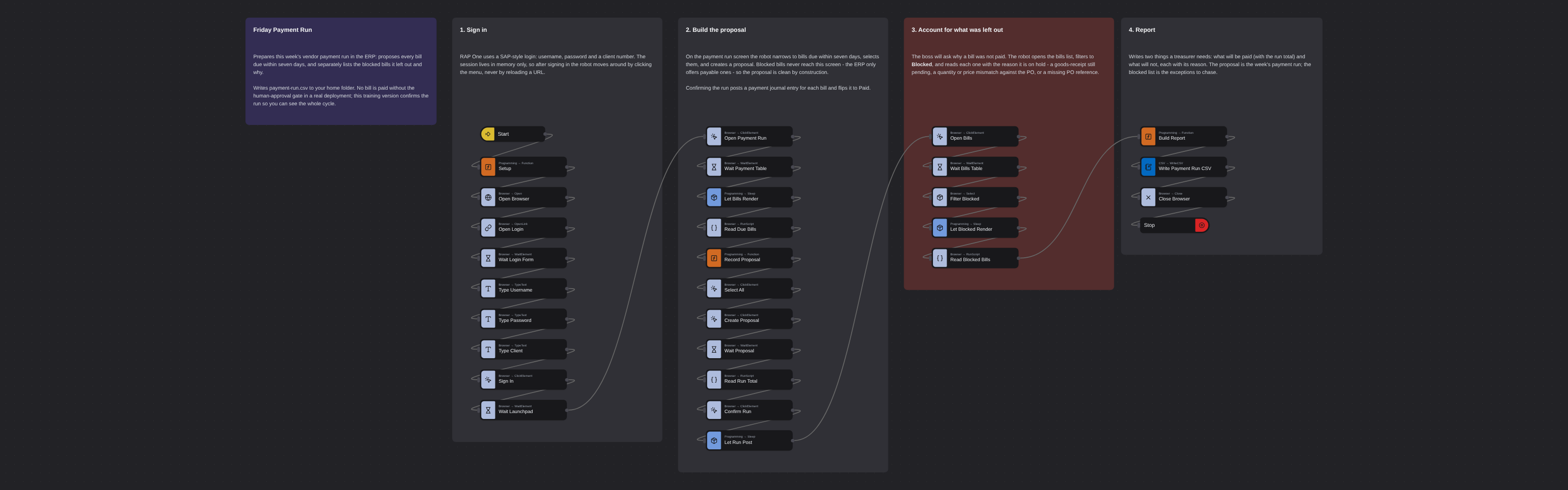
Prepares a weekly vendor payment run in the ERP. Signs in, proposes every bill due within seven days and confirms the run, then separately opens the bills list, filters to the blocked bills the run left out, and reports each one with the reason it is on hold - a pending goods receipt, a quantity or price mismatch against the purchase order, or a missing PO reference. Writes a CSV of what will be paid and what will not.
Friday Payment Run
Every week someone in accounts payable pays the bills that are due, then explains to their manager which ones they held back and why. It is routine, it is repetitive, and it is exactly the kind of thing that gets done at 5pm on a Friday when nobody is at their sharpest.
This flow prepares the run. It proposes every bill due within the next seven days, and — the part that actually earns trust — it accounts for the bills it did not pay, each with the reason it is on hold.
It runs against RAP One, a fictional SAP-style ERP used for training. All data is synthetic.
What it produces
payment-run.csv in your home folder, in two parts:
- Proposed for payment — the bills due within seven days, with the run total.
- Excluded (blocked) — the bills the run left out, each with its reason: a goods receipt not yet confirmed, a quantity or price mismatch against the purchase order, or a missing PO reference.
On the seeded ledger that is 4 bills proposed and 7 blocked.
How it works
1. Sign in
RAP One uses a SAP-style login: username, password and a client number. The session lives in memory only, so after signing in the robot navigates by clicking the menu, never by reloading a URL — a reload would drop it straight back to the login screen.
2. Build the proposal
On the payment run screen the robot narrows to bills due within seven days, selects them and creates a proposal. Blocked bills never appear here — the ERP only offers payable ones — so the proposal is clean by construction. Confirming the run posts a payment journal entry for each bill and flips it to Paid.
In a real deployment this is where the human-approval gate goes: draft the proposal, email it for sign-off, and only confirm once approved. This training version confirms it directly so you can see the whole cycle.
3. Account for what was left out
The manager's first question is always why wasn't this one paid? So the robot opens the bills list, filters to Blocked, and reads each held bill with its reason. Three of them are genuine exceptions a buyer needs to resolve — a mismatched quantity, a mismatched price, a missing PO — and the rest are simply waiting on a goods receipt.
Running it
Ready to run as-is. It signs in with the published training credentials (HTANAKA, client 100),
which are not secret. Real system credentials belong in the Robomotion Vault, never in a flow.
More web automation templates
See all 20 →- Any browser: Edge and FirefoxA browser flow built from Web Automation nodes that signs in to Acme ERP Web and searches the customers, run on a robot in Edge and then in Firefox, with only the Browser Type changed.
- Headless ChromeThe Web Inspector lesson's flow, run first headed so you can watch it, then headless with Record Session, so the robot keeps a video of the run nobody saw.
- Payment Run with Hold ReportRuns the weekly vendor payment run in a SAP-style ERP and then accounts for every bill it refused to pay. Signs in with credentials read from the Robomotion Vault, proposes the bills due within seven days, confirms the run so a journal entry is posted per document, and verifies the posted summary against the proposal before going on. Then it opens the bills list, filters to the blocked bills, and reports each one with the reason it is on hold - a pending goods receipt, a quantity or price mismatch against the purchase order, or a missing PO reference. Writes a two-section CSV covering what was paid and what was held back, with the value held back totalled.
- Shipment Status ReportSigns in to a carrier portal and sweeps every page of the shipments list into one report, then narrows that sweep to the shipments that need a person. Reads the login from the Robomotion Vault, walks the pager with a Label and a GoTo until the Next control is disabled, and writes two CSVs: the full book, and an exceptions file covering customs holds, failed deliveries and delays, oldest booking first, with the billed value stuck in each one. Closes with a Log line carrying the counts and the total.
- Bank ReconciliationTakes the payments and receipts the ERP could not reconcile and confirms each one against the real bank statement. It pulls the ERP's flagged paid-bill exceptions and open invoices awaiting cash, then signs in to the bank, searches the operating account by reference and reads what actually settled - quantifying the four ways money and ledger drift apart: a missing payment, a transposed amount, a double payment and unapplied cash. Writes a reconciliation CSV. The story is evidence: the ledger raises the question, the bank statement answers it, and every discrepancy comes out with a number attached.
- Logistics Exception CenterBuilds one worklist of every active delivery exception from the carrier, then dedupes it against the systems that may already be handling it - the mailbox that was notified, and the help desk where a ticket may already exist. Joining the three on the tracking number tells the robot which exceptions were mailed, which already have a ticket, and which nobody has picked up yet. Writes a consolidated exception CSV. The story is consolidation: three systems each hold part of the picture, and the robot joins them so a stuck shipment is neither missed nor double-worked.