Fork Branch With Memory Queue
The flow
Overview
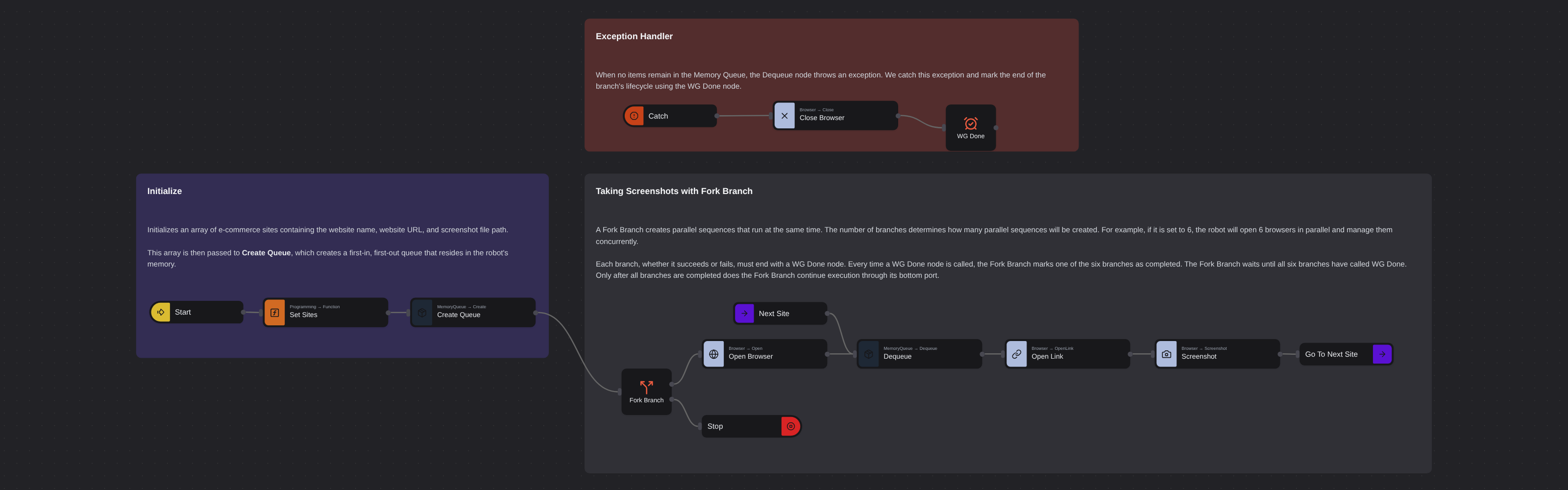
Demonstrates parallel browser automation using Fork Branch and Memory Queue. Creates multiple concurrent browser instances that dequeue items from a shared queue, navigate to e-commerce websites, and take screenshots simultaneously.
Fork Branch with Memory Queue
The Fork Branch with Memory Queue flow is designed to efficiently screenshot large batches of websites by running multiple browser sessions at the same time. It uses a first in first out Memory Queue to hold website information and a Fork Branch to create parallel workers that process sites independently until the queue is empty.
Watch the video
How it works
1. Initialize
The flow begins by preparing an array of e-commerce sites. Each item includes the website name, URL, and screenshot file path. This array is passed into a Memory Queue, creating a FIFO structure stored inside the robot's memory. Every parallel worker will pull from this same queue.
2. Parallel Processing with Fork Branch
A Fork Branch determines how many parallel browser sequences run simultaneously. For example, setting it to six launches six browser sessions that work side by side.
Each branch operates independently:
- Opens a browser
- Dequeues the next website from the Memory Queue
- Opens the link
- Takes a screenshot
- Signals completion with a WG Done node
The Fork Branch waits until all branches have reported completion before continuing, guaranteeing clean synchronization across parallel tasks.
3. Exception Handling
When no items remain in the Memory Queue, the Dequeue node throws an exception. An Exception Handler catches this event, closes the browser for that branch, and signals branch completion using WG Done. This ensures the automation ends gracefully without leaving open sessions behind.
What this flow enables
- High speed screenshot capture for large lists of sites
- Efficient use of parallel browser sessions
- Automatic load balancing through FIFO queue distribution
- Safe shutdown of branches when work is complete
This architectural pattern is ideal for large scale, parallelizable tasks such as monitoring, scraping, or website auditing where each job can be processed independently using shared queued data.
More concurrency templates
See all 4 →- Refund QueueA work queue with both halves built for real: an intake that puts refund requests on a workspace queue one at a time, and a worker loop that takes them off, decides each one, and records Successful or Failed against it. Items are encrypted with an AES key from your vault before they leave the robot, so the Admin Console keeps the history of every item without ever being able to read one. Cut a single wire and the two halves become an intake you can schedule and a worker you can run on any number of robots.
- Bulk Shipment Tracking SweepChecks 200 shipment tracking numbers on a public carrier tracker using eight parallel workers pulling from a shared in-memory queue. Reads the tracking list straight from the carrier's bulk page, scrapes status, latest event and ETA for each shipment, and writes a full status CSV plus an exceptions-only CSV covering customs holds, failed deliveries and delays. No login required.
- Clinic Eligibility Morning RunVerifies insurance for every appointment on a clinic's eligibility worklist, running the payer checks on nine parallel browsers instead of one at a time. Signs in, reads the worklist, fans out into workers that each claim an appointment from a shared queue, click its eligibility check and read the coverage answer. Writes a full status CSV plus a coverage-problems CSV listing the lapsed and not-covered patients the front desk has to chase.