What Is Workflow Orchestration?
Anil Yarimca
TL;DR
Workflow orchestration is the coordination layer that controls how work moves across systems, automations, and people from start to finish. It defines execution order, dependencies, retries, and escalation rather than the individual tasks themselves. Most automation failures in production are orchestration failures, not logic failures.
Many teams believe they have workflows because tasks run in a certain order.
In reality, they often have chains of scripts, scheduled jobs, or loosely connected automations. These setups work until something unexpected happens. A dependency fails. Data arrives late. One step succeeds but the next one does not.
This is where workflow orchestration becomes visible.
Workflow orchestration is not about what each step does. It is about how the system behaves when steps interact over time, fail, retry, or require human input.
Without orchestration, workflows are fragile. With orchestration, they become operable systems.
What workflow orchestration actually means
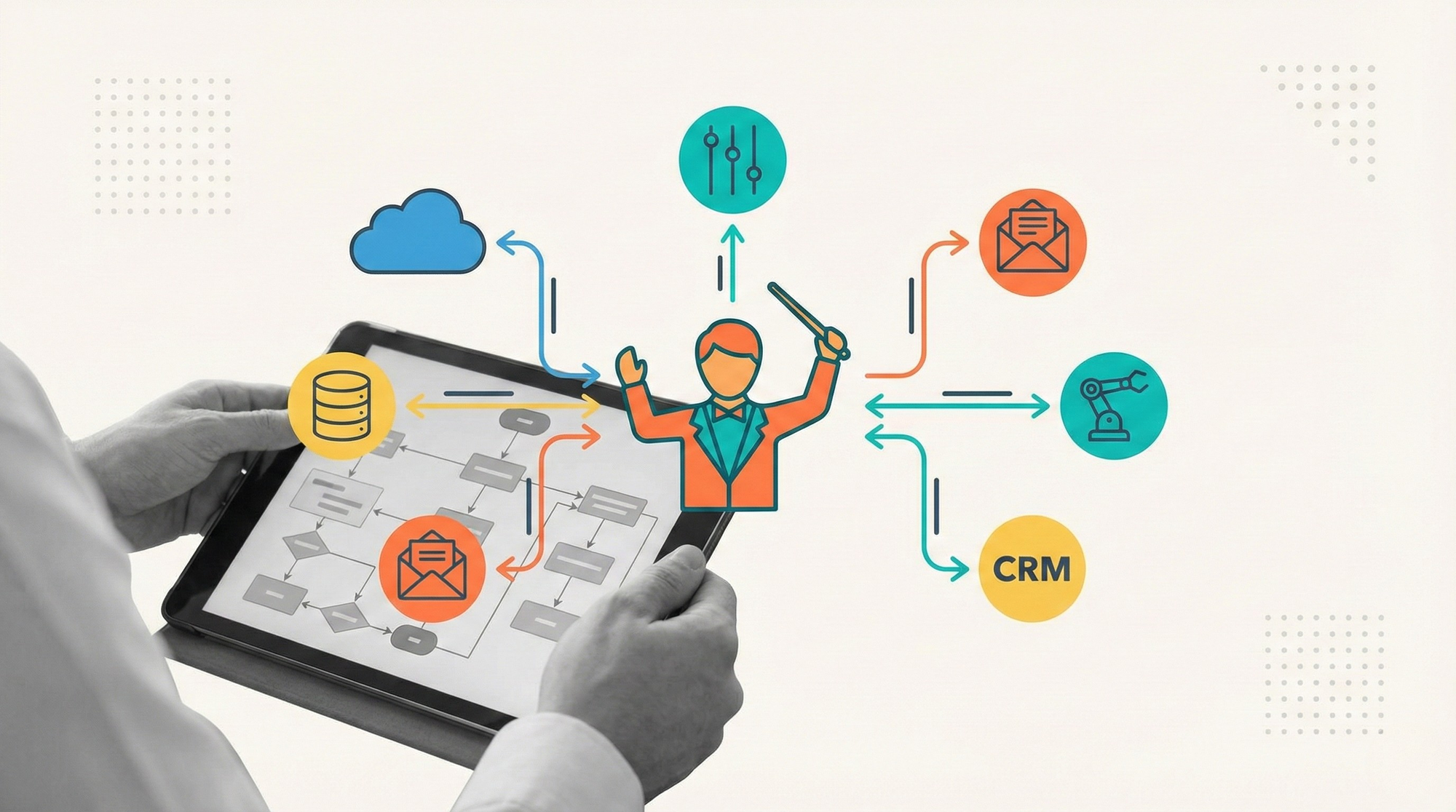
Workflow orchestration refers to the control layer that manages execution across multiple steps, systems, and actors.
It answers questions such as:
- When should a workflow start
- Which steps run in what order
- What happens if a step fails
- How retries are handled
- When humans are involved
- How state is tracked across time
Orchestration does not perform work. It coordinates work.
This distinction is critical. Execution happens inside tasks. Orchestration governs the process.
Workflow orchestration vs task automation
Task automation focuses on individual actions.
Examples include sending an email, updating a record, or running a script.
Workflow orchestration focuses on the relationship between tasks.
It ensures that:
- Tasks run only when prerequisites are met
- Failures do not cascade
- Partial progress is preserved
- The system knows what to do next
Automating tasks without orchestration leads to brittle systems that are hard to recover.
Workflow orchestration vs scheduling
Scheduling is often mistaken for orchestration.
Scheduling answers one question. When should something run.
Workflow orchestration answers many more. What should run next. What depends on what. What should happen if something fails or takes too long.
A scheduled job that runs every night is not orchestrated. A workflow that reacts to events, tracks state, and adapts to outcomes is.
Core components of workflow orchestration
Production-grade workflow orchestration systems include several key components.
Triggers
Triggers define how workflows start. They can be time-based, event-based, or condition-based.
Good orchestration avoids hardcoding start conditions into individual tasks.
Step coordination
Orchestration defines execution order and branching logic.
Steps can run sequentially, in parallel, or conditionally based on outcomes.
State management
The system tracks where each workflow instance is.
This allows workflows to pause, resume, retry, or recover without starting over.
Error handling and retries
Orchestration decides what happens when something fails.
Retry immediately, retry later, skip, escalate, or stop entirely. These are orchestration decisions.
Human-in-the-loop steps
Orchestration controls when human input is required and how workflows resume afterward.
This keeps humans inside the process rather than outside it.
Observability
Orchestration provides visibility into progress, bottlenecks, and failures.
Without observability, workflows cannot be operated reliably.
Why workflow orchestration matters in production
Production systems are unpredictable.
External systems fail. Data quality varies. Volumes spike. Manual intervention is sometimes unavoidable.
Workflow orchestration absorbs this variability.
It prevents single failures from breaking entire processes. It makes recovery predictable. It gives teams confidence that automation will behave consistently.
Most large-scale automation programs eventually realize that orchestration is more important than any individual automation step.
Common orchestration failure modes
Teams often encounter the same problems.
One is linear chaining. One script calls another, which calls another. When one step fails, everything collapses.
Another is hidden orchestration. Logic is spread across scripts, schedules, and configuration files with no central visibility.
A third is lack of state. The system does not know what has already happened, so recovery means starting over.
These failures are not technical edge cases. They are architectural issues.
Workflow orchestration in automation and RPA
In automation and RPA, orchestration is what turns bots into systems.
Bots perform tasks. Orchestration decides when bots run, what work they pick up, and how exceptions are handled.
Queue-based processing, retries, and human review all depend on orchestration.
Without it, bots become isolated workers that are difficult to manage at scale.
Workflow orchestration with AI and agents
As AI and agents are added to workflows, orchestration becomes even more important.
AI outputs are probabilistic. Agents may choose different paths based on context.
Orchestration defines:
- When AI runs
- How results are validated
- What happens when confidence is low
- When humans are involved
This prevents intelligent components from behaving unpredictably.
Recent guidance from AI engineering organizations consistently emphasizes that AI systems must operate inside controlled execution frameworks. Workflow orchestration provides that framework.
Workflow orchestration vs choreography
Workflow orchestration is often contrasted with choreography.
In orchestration, a central controller manages the process.
In choreography, each component reacts to events and coordinates indirectly.
Most enterprise automation systems favor orchestration because it provides visibility, control, and easier governance.
Choreography can work in distributed systems, but it is harder to reason about in business processes.
How workflow orchestration improves accountability
Orchestrated workflows make responsibility clear.
Teams can see:
- What step failed
- Why it failed
- Who or what should act next
- How long each step took
This clarity is essential for trust, auditing, and continuous improvement.
Without orchestration, accountability is diffuse.
How workflow-first platforms approach orchestration
Workflow-first platforms treat orchestration as the foundation.
They provide:
- Explicit workflow definitions
- Centralized state tracking
- Built-in retries and escalation
- Human-in-the-loop support
- End-to-end monitoring
In platforms like Robomotion, workflows coordinate RPA bots, APIs, AI agents, and human steps under one orchestration layer. Execution is distributed. Control is centralized.
This approach reduces operational complexity and makes systems easier to evolve.
External perspective on workflow orchestration
Workflow orchestration is not unique to automation.
It appears in business process management, distributed computing, and cloud infrastructure. Across these domains, the lesson is consistent. Systems that scale coordinate explicitly.
Automation is no different.
As processes span more systems and involve more intelligence, orchestration becomes the backbone rather than an optional feature.
FAQs
What is workflow orchestration in simple terms?
It is the system that controls how tasks run together as a process, including order, retries, and failures.
Is workflow orchestration the same as a workflow?
A workflow defines steps. Orchestration manages execution of those steps over time.
Do small automations need orchestration?
Very simple tasks may not. Anything that runs repeatedly in production usually does.
How does orchestration handle failures?
It decides whether to retry, pause, escalate, or stop based on defined rules.
Can workflow orchestration include humans?
Yes. Human-in-the-loop steps are a core orchestration capability.
Is orchestration necessary with AI and agents?
Yes. AI and agents increase variability, which increases the need for orchestration.
Conclusion
Workflow orchestration is what turns automation into a system rather than a collection of tasks.
It provides control, visibility, and predictability in environments where things inevitably go wrong.
Teams that invest in orchestration build workflows that survive scale, change, and complexity. Teams that skip it spend their time restarting jobs and explaining failures.
In modern automation, workflow orchestration is not an advanced feature. It is the operating model that makes everything else work.