What Is Orchestration in RPA?
Anil Yarimca
TL;DR
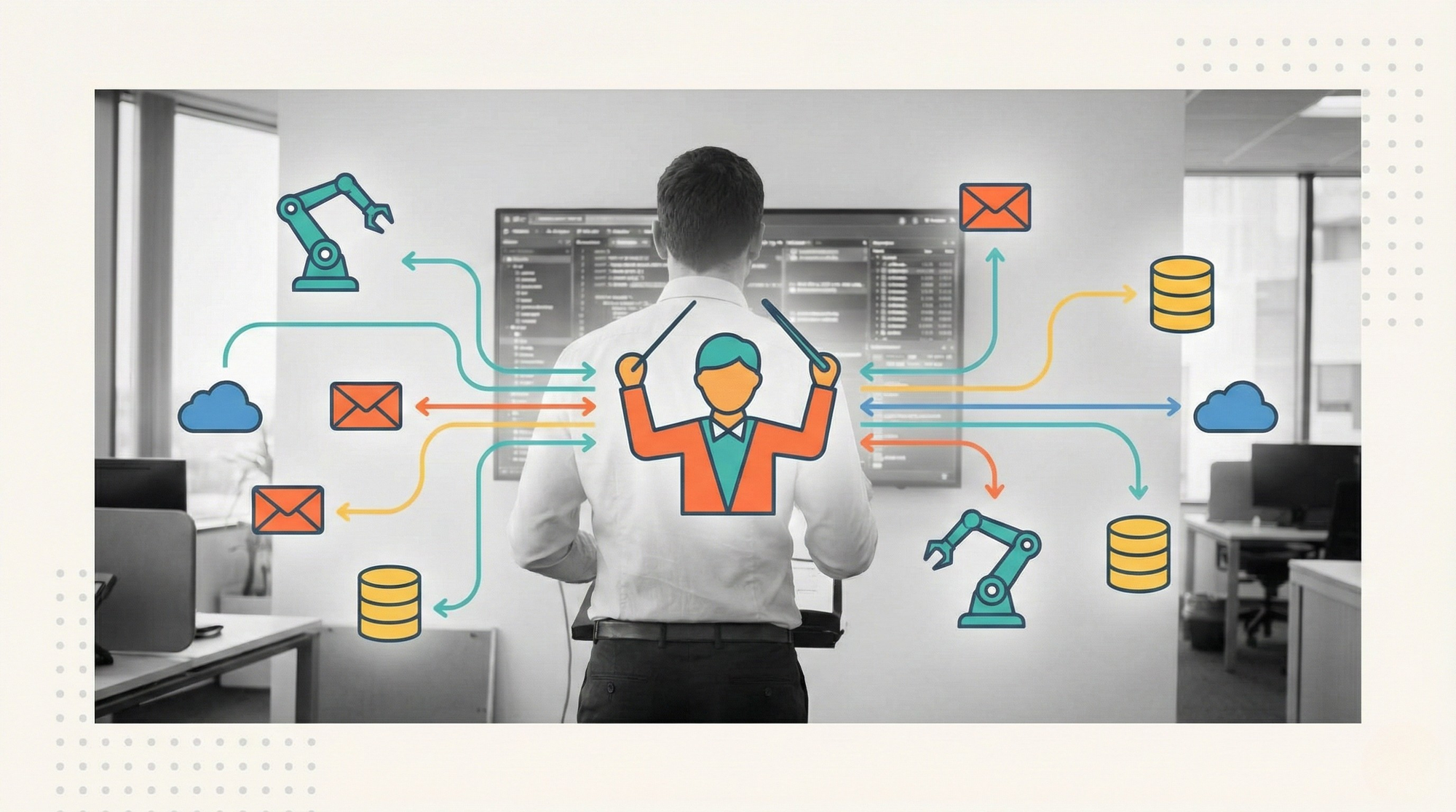
Orchestration in RPA is the layer that coordinates bots, queues, triggers, systems, and humans into a single operating process. It determines when automations run, in what order, and how failures are handled. Most RPA programs that fail in production do so because orchestration is missing or treated as an afterthought.
Many RPA teams believe they are doing orchestration when they are really just scheduling bots.
A bot runs at night. Another bot runs after it. If something fails, someone restarts it manually. This works for a while. Then volumes grow, dependencies multiply, and small failures turn into operational incidents.
This is where orchestration becomes critical.
Orchestration is what turns individual bots into a system. It defines how work flows across bots, how dependencies are managed, how errors are isolated, and how humans are involved when automation cannot proceed safely.
Without orchestration, RPA remains a collection of scripts. With orchestration, it becomes an operational platform.
What orchestration means in RPA terms
In RPA, orchestration is the control layer that manages execution across automations.
It answers questions such as:
- When should a bot start
- Which bot should process which work item
- What happens if a step fails
- How parallel execution is controlled
- When humans need to intervene
Orchestration does not perform the work itself. It coordinates how and when work is performed.
This distinction is important. Bots execute tasks. Orchestration manages the system.
Orchestration vs scheduling
Scheduling is a small part of orchestration, but they are not the same.
Scheduling answers one question. When should something run.
Orchestration answers many more. What should run next. What depends on what. What happens if something fails. Whether work should be retried, paused, or escalated.
Teams that rely only on schedules often encounter race conditions, partial failures, and manual recovery work.
Orchestration replaces rigid schedules with state-aware execution.
Core elements of orchestration in RPA
Triggers
Triggers decide when orchestration begins. This can be time-based, event-based, or state-based.
Good orchestration supports multiple trigger types and avoids hardcoding start conditions into bots.
Queues
Queues decouple work creation from work execution.
Orchestration uses queues to distribute work, control concurrency, and isolate failures at the item level rather than the process level.
This pattern is consistently recommended in enterprise RPA design guidance, including vendor best practices from UiPath and Blue Prism.
Bot allocation and concurrency
Orchestration controls how many bots run, which bots pick up which tasks, and how load is balanced.
Without this, scaling RPA becomes trial and error.
Dependencies and sequencing
Many processes require steps to happen in a specific order.
Orchestration ensures that downstream automations only run when prerequisites are met, rather than assuming success.
Error handling and escalation
When something goes wrong, orchestration decides what happens next.
Retry, skip, route to a human, or stop entirely. These are orchestration decisions, not bot decisions.
State management
Orchestration tracks where work is in the process.
This state awareness is what allows workflows to resume, retry, or recover without starting over.
Why orchestration matters in production RPA
Production environments are unpredictable.
Systems go down. Data arrives late. Bots crash. If orchestration is weak, every failure becomes a manual incident.
Strong orchestration provides:
- Failure isolation
- Clear recovery paths
- Visibility into progress and backlog
- Predictable scaling behavior
Most mature RPA programs eventually realize that orchestration is more important than individual bot logic.
Common orchestration anti-patterns
Many RPA teams struggle because they fall into the same traps.
One anti-pattern is bot-centric design. Bots decide what to do next instead of orchestration.
Another is linear chaining. Bot A calls Bot B, which calls Bot C. When something fails, the entire chain breaks.
A third is hidden orchestration. Logic is spread across bots, scripts, and schedules with no central visibility.
These patterns work early and collapse later.
Orchestration in queue-based RPA
Queue-based architectures are where orchestration becomes visible.
Work is added to queues. Bots pull items when available. Orchestration controls retries, priorities, and escalation.
This model allows RPA systems to behave more like services than batch jobs.
It also aligns RPA with proven distributed system patterns used in message queues and job schedulers, such as those described in general system design literature around event-driven architectures.
Orchestration and human-in-the-loop
Orchestration is what makes human-in-the-loop automation possible at scale.
When a bot encounters a business exception, orchestration can pause the workflow, notify a human, and resume once a decision is made.
Without orchestration, human involvement happens outside the system through emails or chats, breaking traceability.
Well-orchestrated systems keep humans inside the workflow.
Orchestration and AI-augmented RPA
As AI components are added to RPA, orchestration becomes even more critical.
AI outputs are probabilistic. Confidence varies. Some results need validation.
Orchestration defines when AI agents run, how their outputs are validated, and what happens when confidence is low.
Recent AI engineering guidance, including OpenAI’s recommendations for reliable AI systems, consistently stresses that AI must operate within controlled execution frameworks. Orchestration provides that control.
How workflow-first platforms approach orchestration
Workflow-first platforms treat orchestration as the foundation rather than an add-on.
They provide:
- Explicit workflows
- Centralized state
- Unified logging
- Consistent error handling
In platforms like Robomotion, bots, queues, triggers, and AI agents all operate under the same orchestration layer. This reduces operational complexity and makes behavior observable.
Instead of stitching together scripts, teams design processes.
External perspective on orchestration
Orchestration is not unique to RPA.
It appears in business process management, distributed computing, and cloud infrastructure. Systems that scale coordinate components explicitly.
The same principles apply in RPA. Execution without orchestration does not scale. Coordination does.
FAQs
What is orchestration in RPA in simple terms?
It is how RPA systems coordinate bots, work, and decisions so processes run reliably.
Is orchestration the same as a workflow?
A workflow defines the process. Orchestration executes and manages it over time.
Do small RPA projects need orchestration?
Very small tasks may not. Most production systems do.
Can bots orchestrate themselves?
They can, but this usually leads to fragile designs. Central orchestration is more reliable.
How does orchestration help with scaling?
It controls concurrency, isolates failures, and balances load across bots.
Does orchestration replace queues and triggers?
No. It uses them as building blocks.
Conclusion
Orchestration is the backbone of production RPA.
Bots do the work, but orchestration decides how work flows, how failures are handled, and how the system behaves under pressure.
Teams that invest in orchestration build RPA systems that scale and survive. Teams that ignore it spend their time restarting bots and explaining outages.
In RPA, orchestration is not an advanced feature. It is the operating model that turns automation into a system.