What Is Human-in-the-Loop Automation?
Anil Yarimca
TL;DR
Human-in-the-loop automation combines automated systems with intentional human intervention at defined points. It allows organizations to scale automation without losing control, especially when judgment, ambiguity, or risk is involved. Most production-grade RPA and AI systems rely on human-in-the-loop design, even when they appear fully automated.
Automation is often presented as a binary choice. Either a process is automated, or a human handles it. In practice, this framing breaks down very quickly.
Real-world processes are messy. Data is incomplete. Rules have exceptions. Some decisions require context that machines do not reliably have. Fully automated systems struggle in these conditions, while fully manual systems do not scale.
Human-in-the-loop automation exists to bridge this gap. It treats humans not as a failure fallback, but as a designed component of the system.
This concept is especially important in RPA, AI-driven workflows, and agent-based automation, where the cost of a wrong decision can be higher than the cost of slowing down.
What human-in-the-loop means in automation
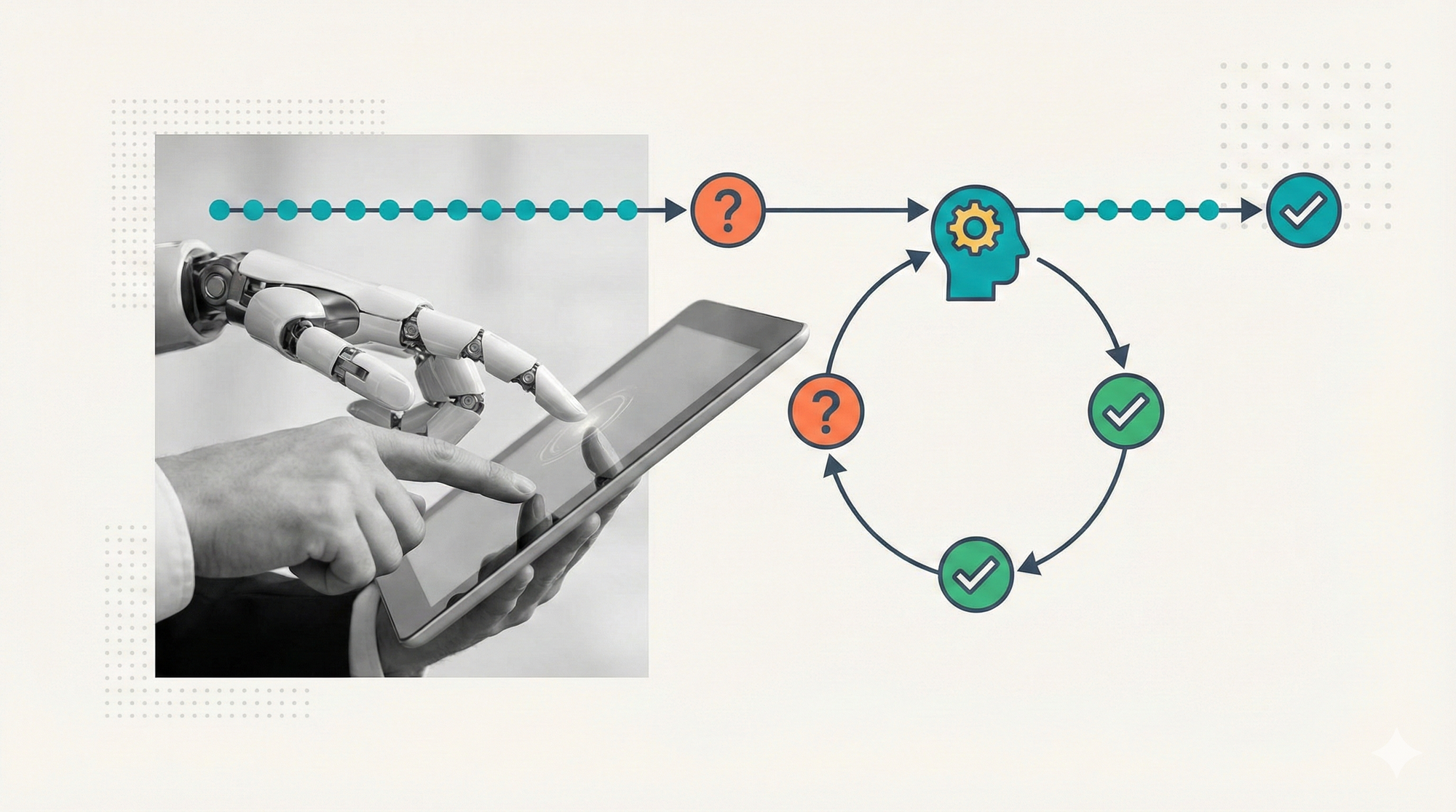
Human-in-the-loop automation means that a workflow includes explicit steps where a human reviews, approves, corrects, or decides before the process continues.
The key word is explicit.
Humans are not intervening because something broke. They are involved because the system is designed that way.
These touchpoints are usually triggered by:
- Low confidence results
- Business rule violations
- High-risk decisions
- Ambiguous or incomplete data
Once the human acts, the workflow resumes automatically.
Human-in-the-loop vs manual work
Human-in-the-loop automation is not the same as manual processing.
In manual work, humans perform the entire process from start to finish.
In human-in-the-loop systems:
- Automation handles the majority of steps
- Humans handle only specific decisions
- The system controls when and how humans are involved
This distinction matters because it preserves scale. Humans focus on judgment, not repetition.
Why human-in-the-loop automation is critical in production
Many automation failures come from trying to remove humans entirely.
In production, this often leads to:
- Silent errors
- Overly conservative logic
- Loss of trust from business teams
Human-in-the-loop design acknowledges a simple reality. Some decisions should not be automated blindly.
This is especially true in regulated industries, customer-facing processes, and systems that involve financial or legal impact.
Research and practitioner guidance around trustworthy AI, including work published by organizations like NIST on AI risk management, consistently emphasize the role of human oversight in reliable systems.
Common use cases for human-in-the-loop automation
Human-in-the-loop patterns appear across many automation scenarios.
In document processing, automation extracts and classifies data. Humans review low-confidence fields or exceptions.
In customer operations, agents resolve standard cases automatically. Humans handle edge cases with full context.
In finance and compliance, automation prepares transactions. Humans approve or reject before execution.
In AI-driven decisions, humans validate outputs when confidence scores fall below thresholds.
In all cases, the system decides when human input is required. Humans do not need to monitor constantly.
Where teams get human-in-the-loop wrong
A common mistake is adding humans only after failures.
This turns people into firefighters rather than reviewers. It increases workload and frustration.
Another mistake is unclear responsibility. When it is not clear who should respond to an escalation, workflows stall.
Teams also underestimate latency. Human-in-the-loop steps introduce delay. Workflows must be designed to tolerate this without breaking downstream systems.
Finally, some teams treat human input as informal. Decisions are made outside the system, through chat or email, and never recorded. This destroys traceability.
Designing effective human-in-the-loop steps
Effective human-in-the-loop automation starts with clarity.
First, define why human input is needed. Is it judgment, approval, correction, or escalation.
Second, define when it is needed. Confidence thresholds, rule violations, or specific conditions should trigger involvement.
Third, define what context the human receives. Inputs, prior steps, and recommended actions should be visible.
Fourth, define what happens after. The workflow must resume predictably based on the human decision.
Without these elements, human-in-the-loop steps become bottlenecks instead of safeguards.
Human-in-the-loop in RPA
In RPA, human-in-the-loop often appears as exception handling.
Bots process queue items automatically. When a business exception occurs, the item is routed to a human for review.
Once resolved, the item re-enters the queue or continues the workflow.
This pattern allows bots to handle volume while humans handle judgment.
Most mature RPA programs rely heavily on this model, even if it is not always visible to end users.
Human-in-the-loop in AI and agent workflows
AI introduces uncertainty that makes human-in-the-loop design even more important.
AI outputs are probabilistic. Even when accuracy is high, confidence varies.
Human-in-the-loop automation allows systems to:
- Flag uncertain results
- Prevent irreversible actions
- Learn from corrections
Recent guidance on deploying AI agents in production, including OpenAI’s own recommendations, highlights that human oversight is essential for safety and reliability, especially in decision-making systems.
Observability and accountability
Human-in-the-loop steps improve accountability, but only if they are observable.
Teams need to track:
- When a workflow paused
- Who made the decision
- What decision was made
- How long it took
This data is critical for auditing, improvement, and trust.
Without observability, human-in-the-loop becomes invisible labor.
How workflow-first platforms enable human-in-the-loop automation
Human-in-the-loop design is difficult to retrofit.
Workflow-first platforms make it easier by treating human steps as first-class workflow components.
In platforms like Robomotion, workflows can pause, notify users, collect structured input, and resume automatically. Bots, queues, and AI agents all respect these pauses.
This keeps humans inside the system rather than around it.
The result is automation that scales without pretending humans are unnecessary.
External perspective on human-in-the-loop systems
Human-in-the-loop is not unique to automation.
It is a core concept in safety-critical systems, aviation, healthcare, and industrial control. Systems that matter rarely operate without human oversight.
Automation is following the same path. Removing humans entirely is rarely the goal. Using them intentionally is.
FAQs
What is human-in-the-loop automation in simple terms?
It is automation that includes planned points where humans review or decide before the process continues.
Does human-in-the-loop mean automation is weak?
No. It means automation is designed for real-world conditions where judgment and accountability matter.
When should humans be kept in the loop?
When decisions are risky, ambiguous, regulated, or hard to reverse.
Does human-in-the-loop reduce efficiency?
It reduces errors and rework. Overall system efficiency often improves even if individual cases take longer.
Can human-in-the-loop steps be automated later?
Sometimes. Many teams start with human review and gradually automate parts as confidence grows.
How is human-in-the-loop different from exception handling?
Exception handling reacts to failures. Human-in-the-loop is designed proactively as part of the normal flow.
Conclusion
Human-in-the-loop automation is not a compromise. It is a design choice.
Systems that ignore human judgment often fail quietly or catastrophically. Systems that rely entirely on humans do not scale.
By combining automation with intentional human involvement, organizations build systems that are faster, safer, and more trustworthy.
In modern RPA and AI-driven automation, keeping humans in the loop is not a weakness. It is how production systems survive.