What Is Exception Handling in RPA?
Anil Yarimca
TL;DR
Exception handling in RPA is the practice of detecting, managing, and resolving errors during automation runs without breaking the entire process. It is one of the main differences between a demo automation and a production-ready system. Most RPA failures happen not because bots cannot perform tasks, but because exceptions are not handled intentionally.
Most RPA automations work perfectly until something unexpected happens. A screen loads slowly. A field is empty. A system returns an error message. A network call times out.
In early projects, these situations are treated as edge cases. In production, they are the norm.
Exception handling is what allows an RPA process to survive real-world conditions. Without it, bots stop, data is left half-processed, and business teams lose trust in automation. With it, failures become manageable events instead of incidents.
Understanding exception handling is essential for anyone designing or operating RPA in production.
What exception handling means in RPA
In RPA, an exception is any situation where the automation cannot proceed as expected.
This can include system errors, missing data, unexpected UI changes, validation failures, or business rule violations. Exception handling is the logic that determines what the bot should do when these situations occur.
Exception handling is not about avoiding errors. It is about deciding what happens after an error occurs.
This distinction is critical. Production systems assume failure and are designed around recovery.
Types of exceptions in RPA
System exceptions
System exceptions occur when something goes wrong in the technical environment.
Examples include application crashes, selectors not found, network issues, or timeouts. These are usually outside the control of the bot logic.
System exceptions often require retries or escalation, but they should not silently fail.
Business exceptions
Business exceptions occur when the automation runs correctly, but the data or situation does not meet business rules.
Examples include missing mandatory fields, invalid values, duplicate records, or transactions that require manual approval.
Business exceptions are expected conditions. They should be handled deliberately, not treated as errors.
Understanding the difference between system and business exceptions is a core RPA best practice and is emphasized in guidance from major RPA vendors like UiPath.
Why exception handling is critical in production RPA
Production environments are unstable by nature.
Applications change. Data quality varies. External systems slow down or fail. Bots that assume perfect conditions will break frequently.
Exception handling provides:
- Resilience, by allowing retries or alternative paths
- Visibility, by logging what went wrong and where
- Control, by deciding when to stop and when to continue
Without exception handling, RPA becomes brittle and expensive to operate.
Exception handling vs error catching
Many teams confuse exception handling with simple error catching.
Error catching stops the bot from crashing. Exception handling decides what to do next.
Catching an error without handling it usually means logging the issue and stopping execution. Handling an exception means making a decision, retrying, skipping, routing, or escalating.
Production-grade RPA requires the second approach.
Common exception handling patterns in RPA
Retry with limits
For transient issues like network failures or slow systems, retries make sense.
Retries should always have limits. Infinite retry loops are a common cause of incidents and queue backlogs.
Skip and continue
For non-critical items, the bot may skip the current transaction and move on.
This is often used in queue-based processing, where one failed item should not block others.
Escalate to humans
Some exceptions require human judgment.
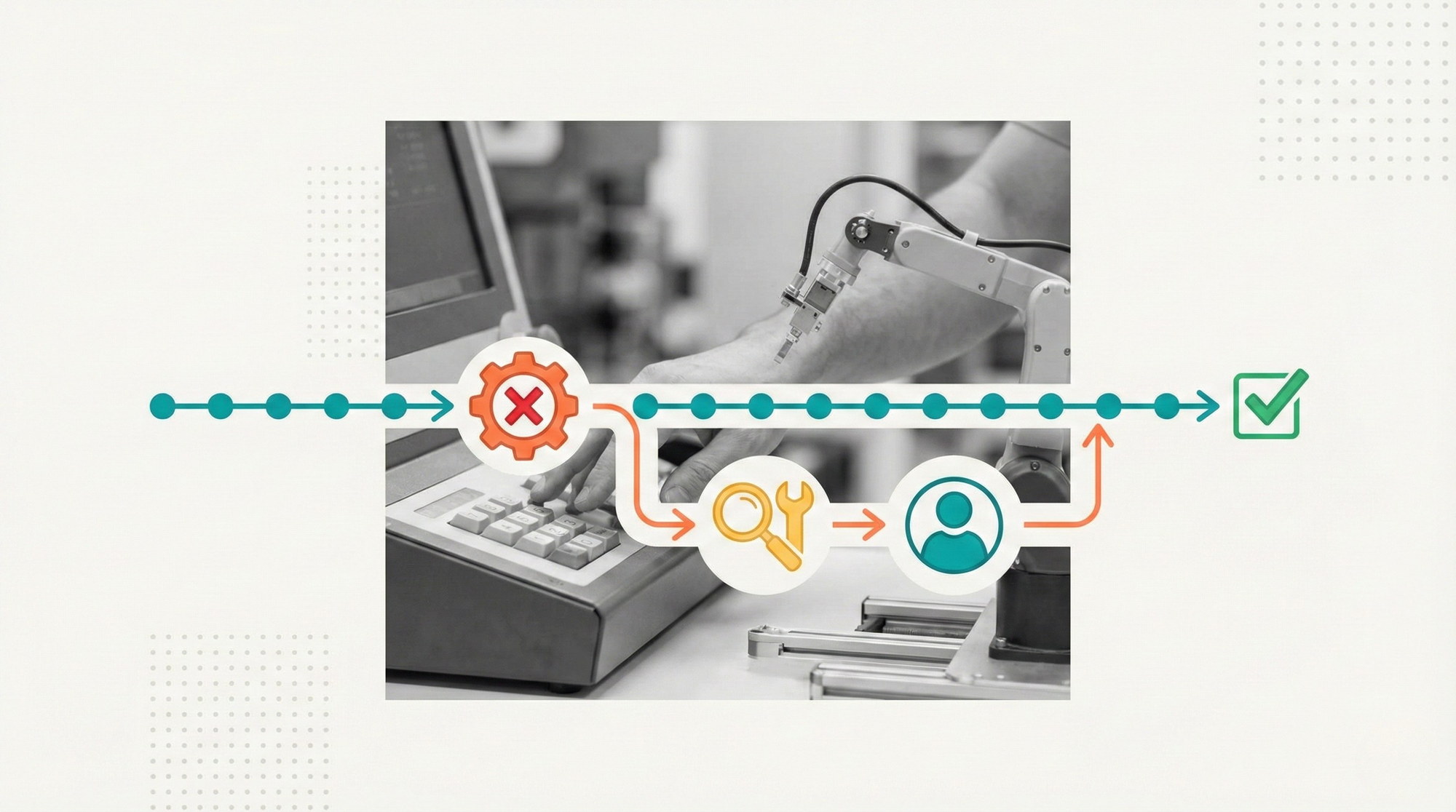
In these cases, the bot should create a ticket, send a notification, or route the item to a human-in-the-loop step with full context.
Fail fast and stop
For critical errors, the safest option is to stop the workflow and alert operators immediately.
Not all failures should be recovered automatically.
Exception handling in queue-based RPA
Queues change how exceptions are handled.
Instead of failing an entire run, exceptions are handled at the item level. One transaction can fail while others continue.
Queue-based exception handling allows:
- Item-level retries
- Clear separation between failed and successful work
- Better reporting and root cause analysis
This is why queues and exception handling are tightly connected in mature RPA architectures.
Observability and exception handling
Exception handling without observability is incomplete.
Teams need to know:
- What exception occurred
- At which step
- With what input data
- How it was handled
Logs, screenshots, error codes, and structured metadata are essential. Without them, exceptions become noise instead of signals.
Modern automation guidance, including material from Gartner on intelligent automation operations, consistently highlights observability as a requirement for scaling RPA programs.
Organizational aspects of exception handling
Exception handling is not only technical. It is organizational.
Someone must decide:
- Which exceptions are acceptable
- Which require human review
- Who owns resolution
- How long retries should continue
When these questions are unanswered, bots either stop too often or run too long without intervention.
Clear ownership turns exception handling from firefighting into operations.
Exception handling in AI-augmented RPA
When AI components are added to RPA, exception handling becomes even more important.
AI outputs are probabilistic. They can be uncertain or ambiguous.
Exception handling may include confidence thresholds, validation steps, or fallback paths when AI results are unclear.
This aligns with broader AI engineering guidance, including OpenAI’s recommendations for building reliable AI systems, which emphasize explicit handling of uncertainty.
How workflow-first platforms improve exception handling
Workflow-first platforms treat exception handling as a first-class concept.
Instead of burying logic inside scripts, workflows make error paths explicit. Retries, escalations, and manual steps are part of the process design.
In platforms like Robomotion, exception handling can be defined at the workflow level. Bots, queues, and AI agents all follow the same rules for failure, recovery, and visibility.
This reduces operational complexity and improves trust.
External perspective on exception handling
Exception handling is not unique to RPA.
It is a foundational concept in software engineering, distributed systems, and operations. Systems that survive production assume failure and design for it.
RPA is simply catching up to this reality.
FAQs
What is exception handling in RPA in simple terms?
It is how an automation detects errors and decides what to do next without breaking the entire process.
What is the difference between system and business exceptions?
System exceptions are technical failures. Business exceptions are expected situations where data or rules do not match requirements.
Do all RPA processes need exception handling?
Yes, if they run in production. Even simple automations encounter unexpected conditions over time.
Can exception handling be fully automated?
Some exceptions can be handled automatically. Others require human review. Both should be designed intentionally.
How do queues help with exception handling?
Queues isolate failures at the transaction level and allow retries or escalation without stopping all work.
What happens if exception handling is missing?
Bots fail unpredictably, work is lost, and trust in automation declines.
Conclusion
Exception handling is what separates experimental RPA from production RPA.
Bots will fail. Data will be messy. Systems will change. These are not problems to eliminate, but realities to manage.
Teams that design exception handling intentionally build automations that can be operated, monitored, and trusted. Teams that do not spend their time restarting bots and explaining failures.
In RPA, exception handling is not an extra feature. It is the operating discipline that makes automation viable.