What Is Attended vs Unattended Automation?
Anil Yarimca
TL;DR
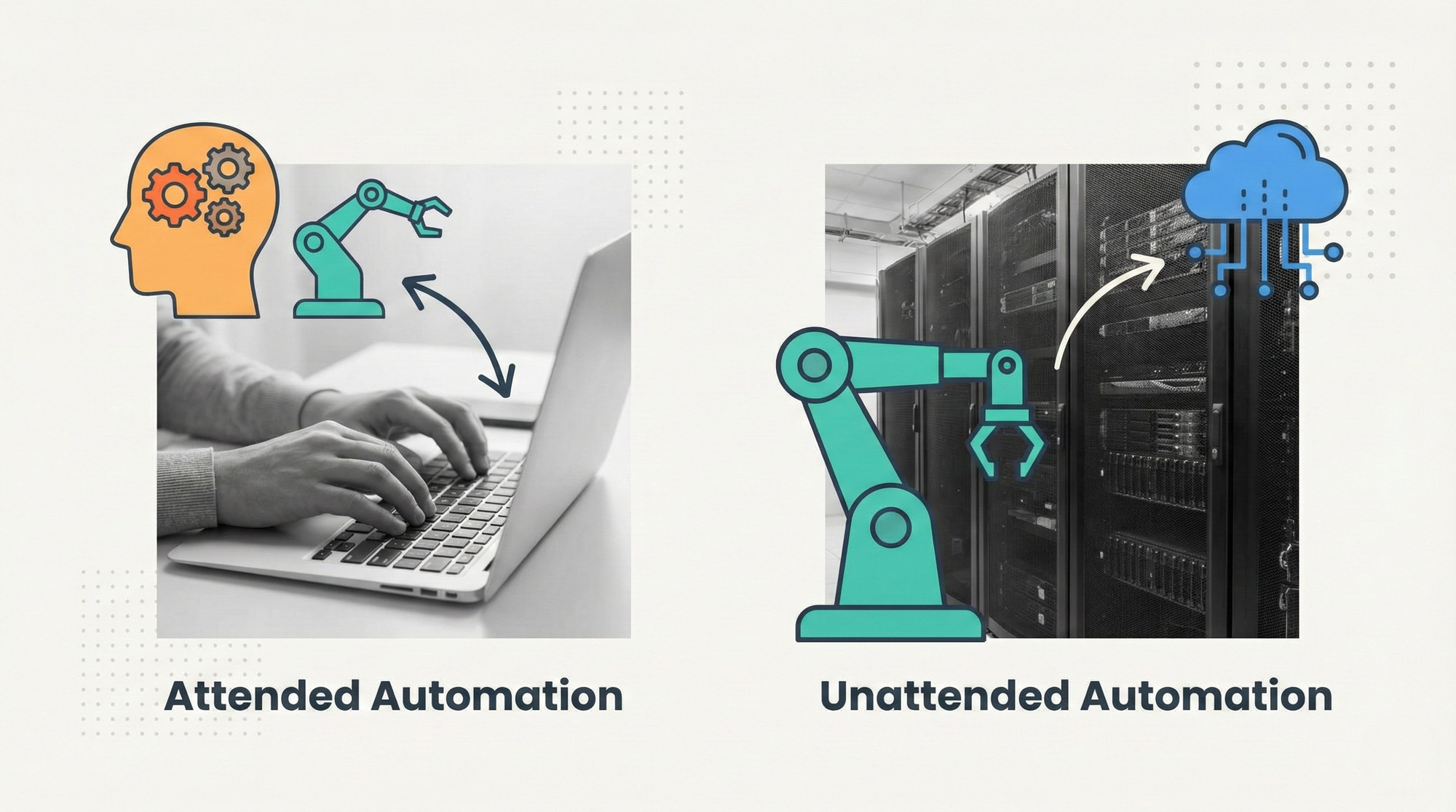
Attended and unattended automation describe who controls when automation runs. Attended automation works alongside humans and is triggered by user actions, while unattended automation runs independently in the background based on schedules or events. Most production automation programs use both, and failures usually happen when the wrong model is applied to the wrong process.
One of the first architectural decisions in RPA and automation projects is whether a process should be attended or unattended. This decision is often treated as a licensing or deployment detail. In reality, it is an operating model choice.
Attended and unattended automation behave very differently in production. They fail in different ways, require different controls, and create different organizational expectations.
Teams that misunderstand this distinction often design processes that feel productive in pilots but become unstable once they scale.
What attended automation means
Attended automation runs in the context of a human user.
A person starts the automation, usually from their desktop, application, or toolbar. The automation assists them by performing steps faster, more consistently, or with fewer errors.
The human remains present. They can intervene, provide input, or stop execution.
Common examples include:
- An agent clicking a button to extract data during a call
- A finance user triggering validation while reviewing a record
- A support rep launching automation to prepare a response
Attended automation optimizes human work. It does not replace it.
What unattended automation means
Unattended automation runs without a human in the loop at execution time.
It is triggered by schedules, events, or system state changes. Once started, it completes work on its own or follows predefined escalation paths.
Common examples include:
- Nightly invoice processing
- Automatic data synchronization between systems
- Queue-driven transaction processing
- Background reconciliation and reporting
Unattended automation is about operational throughput rather than user productivity.
Key differences between attended and unattended automation
The difference is not about technology. It is about control and responsibility.
Attended automation:
- Is initiated by humans
- Runs in user context
- Can rely on human judgment
- Is sensitive to UI and session state
Unattended automation:
- Is initiated by triggers
- Runs in server or robot context
- Must handle errors autonomously
- Requires stronger monitoring and recovery
Understanding these differences is essential for production design.
When attended automation makes sense
Attended automation works best when:
- A human is already part of the process
- Decisions require real-time judgment
- Automation needs immediate user context
- The cost of full automation outweighs the benefit
Attended automation shines in customer-facing roles, knowledge work, and exception-heavy processes.
It is also often used as a transition step. Teams start with attended automation, learn the process, then move parts of it to unattended execution.
When unattended automation is the right choice
Unattended automation is appropriate when:
- Work is high-volume and repetitive
- Processes are well-defined
- Execution does not require human presence
- Reliability and consistency matter more than speed of interaction
Unattended automation is the backbone of most large-scale RPA programs. It is how organizations achieve real capacity gains.
Industry guidance from RPA vendors and automation analysts consistently shows that unattended automation delivers the highest ROI, but only when processes are stable and well-instrumented.
Common mistakes teams make
One common mistake is forcing unattended automation into processes that still require human judgment. This leads to brittle logic and frequent failures.
Another mistake is overusing attended automation for background work. This creates hidden dependencies on human availability and breaks scaling assumptions.
Teams also underestimate governance. Unattended automation without monitoring and exception handling becomes risky very quickly.
Finally, many teams treat the choice as permanent. In reality, processes often evolve from attended to unattended over time.
Attended and unattended automation in the same workflow
Mature automation programs rarely choose one model exclusively.
A single workflow may include:
- Unattended steps that prepare or process data
- Attended steps where humans review or approve
- Unattended follow-up actions once approval is complete
This hybrid approach aligns with human-in-the-loop automation principles and reflects how real processes operate.
This pattern is discussed frequently in modern automation architecture, including workflow orchestration literature and best practice guides from organizations like UiPath.
Operational differences teams underestimate
Attended automation depends on user behavior. If the user closes an application or logs out, automation stops.
Unattended automation depends on infrastructure. If credentials expire or systems change, automation fails silently unless monitored.
These differences affect:
- Error handling
- Security design
- Credential management
- Audit and compliance
Treating attended and unattended automation as interchangeable leads to operational blind spots.
How orchestration ties everything together
The decision between attended and unattended automation should not be made in isolation.
Orchestration defines how and when each type runs, how handoffs happen, and how failures are handled.
Without orchestration, attended automations remain isolated helpers and unattended automations become fragile batch jobs.
Workflow-first orchestration allows teams to combine both models safely.
How platforms support both models
Platforms that support only one automation model limit how systems can evolve.
Workflow-centric platforms like Robomotion support both attended and unattended automation within the same orchestration layer. Triggers, queues, and human-in-the-loop steps coexist.
This allows teams to design based on process needs rather than tool constraints.
External perspective on attended vs unattended automation
The attended versus unattended distinction mirrors broader system design patterns.
Interactive systems optimize for responsiveness. Background systems optimize for throughput and reliability.
Distributed systems literature and operations best practices consistently show that mixing these concerns without clear boundaries creates instability. Automation is no different.
FAQs
What is attended automation in simple terms?
It is automation that runs with a human present and is usually started by the user.
What is unattended automation in simple terms?
It is automation that runs automatically in the background without human involvement.
Which one is better?
Neither is better in general. The right choice depends on the process.
Can attended automation become unattended later?
Yes. Many teams start with attended automation and migrate stable parts to unattended execution.
Do unattended automations require more governance?
Yes. Because no human is present, monitoring, logging, and exception handling are critical.
Can one process use both?
Yes. Hybrid workflows are common and often the most effective.
Conclusion
Attended and unattended automation are not competing approaches. They are complementary operating models.
Attended automation amplifies human capability. Unattended automation delivers scale and reliability.
Production success comes from choosing the right model for each part of a process and orchestrating them together intentionally.
Teams that understand this distinction build automation that grows with the business instead of breaking under it.