What Is AI-Powered RPA?
Anil Yarimca
TL;DR
AI-powered RPA combines traditional robotic process automation with AI capabilities so automations can handle both execution and interpretation. It allows bots to work with unstructured data, make probabilistic decisions, and adapt to variability while still relying on workflows for reliability. Most failures happen when AI is added without proper orchestration and control.
Classic RPA was designed for a predictable world. Structured data, stable screens, and clear rules. When those conditions exist, RPA works extremely well.
The real world rarely looks like that.
Documents come in different formats. Emails are written differently every time. Customer requests are ambiguous. This is where traditional RPA starts to struggle, and where AI-powered RPA enters the picture.
AI-powered RPA is not a replacement for RPA. It is an extension. It adds interpretation and judgment on top of execution. When designed correctly, it allows automation to move beyond rigid scripts without losing control.
What AI-powered RPA actually means
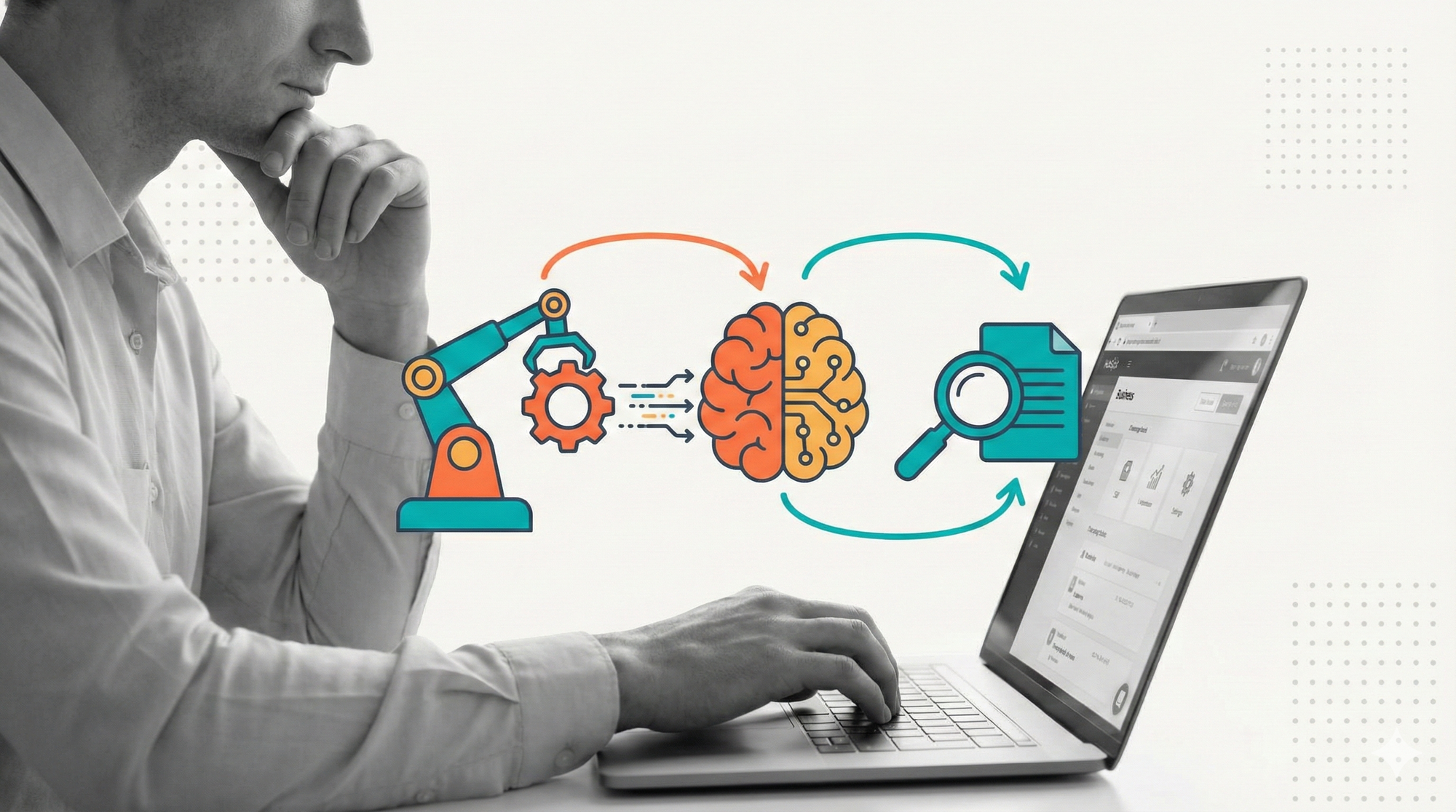
AI-powered RPA refers to automation systems where AI components are used to interpret inputs or support decisions, and RPA bots execute the resulting actions.
The division of labor is important.
- AI handles uncertainty, such as language, documents, images, or classification.
- RPA handles execution, such as entering data, clicking through systems, and triggering transactions.
AI does not replace the bot. It informs the bot.
This separation is what makes AI-powered RPA workable in production environments.
How AI-powered RPA differs from traditional RPA
Traditional RPA assumes inputs are already structured and rules are explicit.
AI-powered RPA accepts that:
- Inputs may be messy or incomplete
- Rules may be probabilistic rather than absolute
- Decisions may require confidence thresholds
For example, instead of hard-coding where to find a value in a document, AI extracts and interprets it. The RPA bot then uses that output to complete the process.
The automation becomes more flexible, but also more complex to operate.
Common AI capabilities used in RPA
AI-powered RPA typically includes a combination of the following capabilities.
Natural language processing is used to understand emails, chat messages, or free-text fields.
Document understanding extracts structured data from invoices, contracts, or forms with varying layouts.
Classification models categorize requests, documents, or transactions.
Prediction and scoring models estimate risk, priority, or likelihood of an outcome.
Large language models are increasingly used to summarize, validate, or reason over context before execution.
These capabilities extend what RPA can work with. They do not change how RPA executes.
Why AI-powered RPA matters in production
Pure RPA breaks when variability increases. Pure AI breaks when execution must be reliable.
AI-powered RPA exists because production systems need both flexibility and control.
It allows organizations to:
- Reduce manual handling of unstructured inputs
- Scale automation to more complex processes
- Maintain auditability and predictability
Industry analysis from firms like McKinsey consistently shows that the highest-value automation initiatives combine AI with strong process control rather than treating AI as a standalone solution.
Where AI-powered RPA works well
AI-powered RPA is most effective in processes with a mix of structure and ambiguity.
Common examples include:
- Invoice and document processing
- Customer onboarding
- Claims handling
- Email and ticket triage
- Compliance checks with exceptions
In these cases, AI reduces manual effort, while RPA ensures transactions are completed correctly.
Where teams get AI-powered RPA wrong
Many teams fail by adding AI directly into bots without redesigning the process.
Common mistakes include:
- Trusting AI outputs without validation
- Embedding AI decisions deep inside scripts
- Lacking confidence thresholds or fallbacks
- Treating AI errors as system errors
These issues lead to silent failures or unpredictable behavior.
Guidance from organizations like OpenAI on building reliable AI systems repeatedly emphasizes that AI outputs must be evaluated, monitored, and constrained. AI-powered RPA is no exception.
The role of workflows in AI-powered RPA
Workflows are what make AI-powered RPA safe.
They define:
- When AI runs
- What context it receives
- How outputs are validated
- What happens when confidence is low
- When humans are involved
Without workflows, AI-powered RPA becomes a fragile chain of assumptions.
With workflows, AI becomes a decision-support layer inside a controlled system.
Human-in-the-loop in AI-powered RPA
Most production AI-powered RPA systems include human-in-the-loop steps.
Humans review low-confidence cases, handle edge conditions, or approve high-risk actions.
This is not a failure of automation. It is an intentional design choice that balances speed with trust.
As confidence improves, human involvement may decrease, but it rarely disappears entirely.
Observability and governance challenges
Adding AI increases the need for observability.
Teams need to track:
- AI inputs and outputs
- Confidence scores
- Decisions made based on AI results
- Downstream effects of those decisions
Without this visibility, it becomes impossible to debug issues or explain outcomes.
This is especially important in regulated environments.
How automation-first platforms support AI-powered RPA
Operating AI-powered RPA at scale requires infrastructure.
Automation-first platforms provide workflows, queues, triggers, exception handling, and monitoring as shared capabilities.
In platforms like Robomotion, AI components can be embedded as steps inside workflows. RPA bots execute actions based on validated AI outputs. Failures are routed intentionally.
This keeps AI-powered RPA manageable rather than experimental.
External perspective on AI-powered RPA
AI-powered RPA reflects a broader trend in enterprise systems.
Execution layers remain deterministic. Intelligence layers become adaptive. Control layers grow stronger.
This pattern appears across distributed systems, finance, and operations. Automation that mixes intelligence and execution without control rarely survives production.
FAQs
What is AI-powered RPA in simple terms?
It is RPA that uses AI to understand inputs or support decisions before executing actions.
Is AI-powered RPA the same as intelligent automation?
AI-powered RPA is one form of intelligent automation. Intelligent automation may include other technologies beyond RPA.
Does AI-powered RPA replace traditional RPA?
No. It extends it. Traditional RPA remains responsible for execution.
Do AI-powered RPA systems need human oversight?
Yes, especially for low-confidence or high-risk decisions.
Why do AI-powered RPA projects fail?
Most failures come from poor workflow design, lack of validation, and missing observability.
Is AI-powered RPA suitable for regulated industries?
Yes, when designed with auditability, validation, and human-in-the-loop controls.
Conclusion
AI-powered RPA exists because real processes are neither fully predictable nor fully ambiguous.
By combining AI’s ability to interpret with RPA’s ability to execute, organizations can automate more complex work. But this power comes with responsibility.
The systems that succeed are not those with the most advanced models. They are the ones with the strongest workflows, guardrails, and operating discipline.
AI-powered RPA is not about making bots smarter. It is about making automation more resilient in the real world.