What Is Agentic Automation?
Anil Yarimca
TL;DR
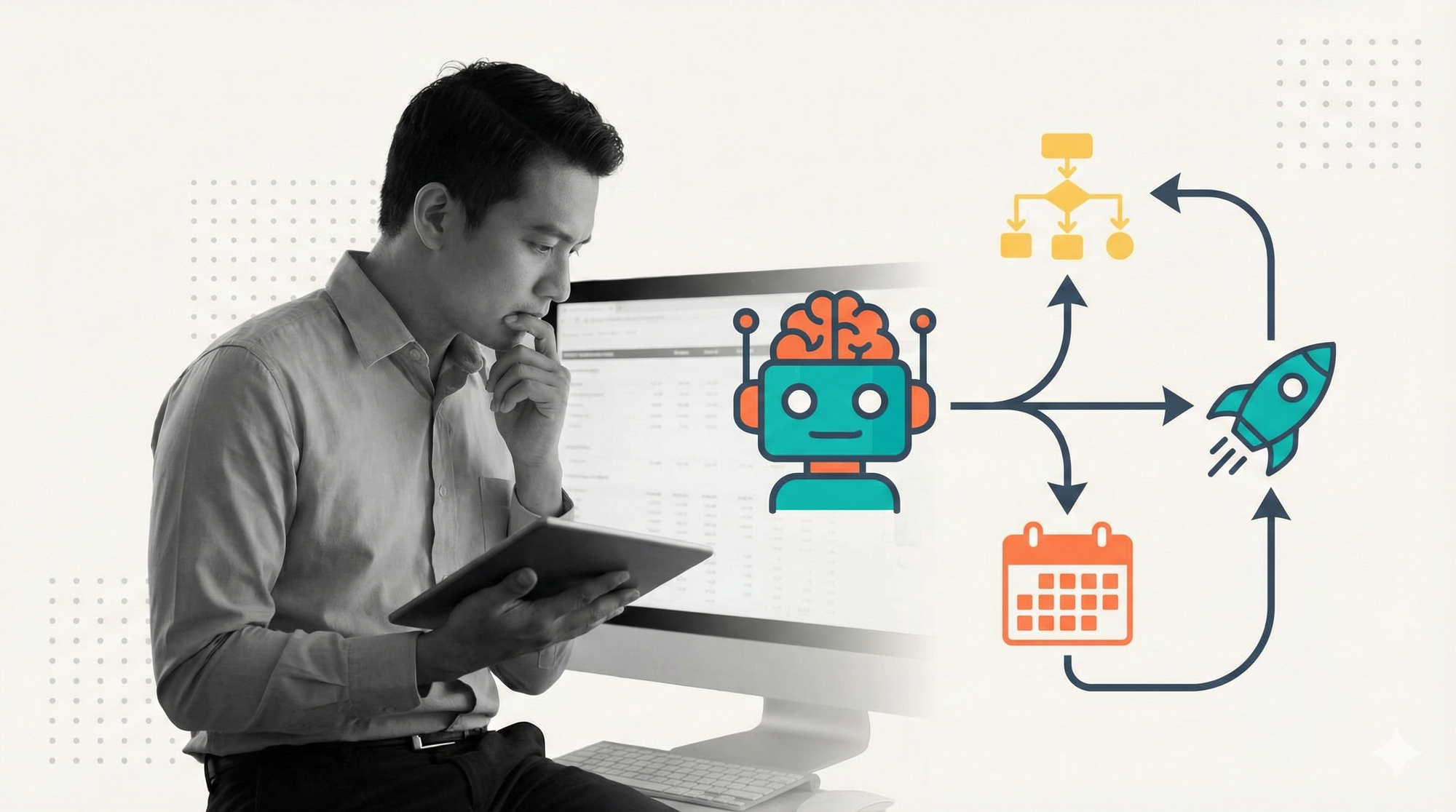
Agentic automation is an automation approach where AI agents take responsibility for planning and executing tasks within defined boundaries. It goes beyond rule-based automation by allowing systems to decide how to act, not just what to execute. Agentic automation works in production only when paired with strong workflows, guardrails, and observability.
Automation has traditionally been about execution. A rule is defined. A bot follows it. If the rule changes, the automation breaks until someone updates it.
AI introduced a different capability. Systems can interpret intent, handle ambiguity, and choose between actions. When these capabilities are combined with automation, a new model emerges. Agentic automation.
Agentic automation is often misunderstood as fully autonomous AI replacing workflows. In practice, the opposite is true. Agentic systems succeed only when they are constrained by structure. Without structure, they fail quickly in production.
This article explains what agentic automation actually is, how it differs from traditional automation and intelligent automation, where it works, where it breaks, and how teams make it operational.
What agentic automation actually means
Agentic automation refers to systems where AI agents are responsible for deciding how to complete tasks, not just executing predefined steps.
Instead of encoding every path explicitly, teams define:
- Goals or desired outcomes
- Available actions or tools
- Constraints and rules
- Evaluation criteria
The agent reasons about the situation and selects actions accordingly.
The key distinction is responsibility. In agentic automation, the agent owns progress toward the goal within defined limits.
Agentic automation vs traditional automation
Traditional automation is deterministic. Given the same input, it produces the same output.
Agentic automation is adaptive. Given the same input, it may choose different paths based on context, state, or learned patterns.
Traditional automation requires detailed upfront design. Agentic automation allows some decisions to be deferred to runtime.
This does not make agentic automation simpler. It makes it different. Design effort shifts from encoding steps to designing boundaries.
Agentic automation vs intelligent automation
Intelligent automation typically adds AI to specific steps within a fixed workflow. AI interprets data. Automation executes actions.
Agentic automation allows the agent to influence the flow itself. The agent can decide what to do next, which tool to use, or whether to escalate.
The risk is obvious. Without limits, the agent becomes unpredictable.
This is why most production-grade agentic systems still rely on workflows. The workflow defines when the agent runs and what it is allowed to do. The agent decides how to act inside that space.
Core components of agentic automation
Most agentic automation systems share the same building blocks.
Agents
Agents are AI-driven components that reason, plan, and select actions. They operate based on goals, context, and available tools.
Tools and actions
Agents do not act directly on systems. They call tools. APIs, RPA actions, database queries, and workflow steps are exposed as controlled actions.
Context and state
Agents require context to make decisions. This includes input data, historical state, and current workflow status.
Context must be curated. Overloaded or stale context is a common failure mode.
Workflows and orchestration
Workflows define when agents run, how often, and what happens after each decision.
This layer prevents agents from running indefinitely or acting outside their scope.
Guardrails and evaluation
Guardrails limit what agents can do. Evaluation checks whether outcomes meet expectations.
These are not optional. They are the difference between experimentation and production.
Where agentic automation works well
Agentic automation is well suited for processes with variability.
Examples include:
- Document processing with diverse formats
- Customer operations with ambiguous requests
- Exception handling where rules are incomplete
- Research, analysis, and triage tasks
In these scenarios, rigid logic breaks down. Agents provide flexibility.
Recent engineering discussions on agent systems, including OpenAI’s guidance on building reliable agents, emphasize that agents are most effective when used to navigate ambiguity rather than replace structured execution.
Where agentic automation fails
Agentic automation fails when teams expect autonomy to replace design.
Common failure patterns include:
- Agents deciding execution order without coordination
- Lack of observability into agent decisions
- No clear stop conditions
- Over-reliance on natural language for control
These systems often work briefly and then collapse under scale or edge cases.
This pattern is echoed in broader industry analysis of autonomous systems, including research from Anthropic and others on constrained autonomy.
Agentic automation and workflows
A critical insight is that agentic automation does not remove the need for workflows. It increases it.
Workflows provide:
- Entry and exit points
- State management
- Error handling
- Human-in-the-loop escalation
The agent operates inside the workflow, not instead of it.
This mirrors patterns in distributed systems. Components with autonomy still require coordination.
Human-in-the-loop in agentic systems
Most production agentic systems include humans.
Humans review low-confidence decisions, handle high-risk actions, or approve outcomes.
Agentic automation does not aim to eliminate humans. It aims to involve them only when needed.
This aligns with established human-in-the-loop principles used in safety-critical systems.
Observability and trust
Trust in agentic automation comes from visibility.
Teams must be able to answer:
- Why did the agent choose this action
- What context was used
- What alternatives were considered
- What happened after
Logs, traces, and structured decision records are essential.
Without observability, agentic systems quickly lose organizational trust.
How automation-first platforms enable agentic automation
Agentic automation is difficult to operate without infrastructure.
Automation-first platforms provide:
- Workflow orchestration
- Controlled tool access
- Context management
- Error handling
- Human-in-the-loop steps
- Monitoring and auditing
In platforms like Robomotion, agents can be embedded as decision-making steps inside workflows. The platform controls execution. The agent provides reasoning.
This separation makes agentic automation practical rather than experimental.
External perspective on agentic automation
Agentic automation reflects a broader trend toward goal-oriented systems.
Similar ideas appear in robotics, operations research, and autonomous systems. Across these fields, the same lesson applies. Autonomy without constraints is unsafe.
Effective systems combine autonomy with control.
FAQs
What is agentic automation in simple terms?
It is automation where AI agents decide how to complete tasks within defined limits instead of following fixed scripts.
Is agentic automation the same as autonomous AI?
No. Agentic automation is constrained autonomy. Fully autonomous AI without guardrails is rarely used in production.
Do agentic systems replace workflows?
No. They depend on workflows to control execution and manage risk.
When should teams use agentic automation?
When processes involve ambiguity, variability, or incomplete rules that traditional automation cannot handle well.
What are the biggest risks of agentic automation?
Unpredictability, lack of observability, and unclear ownership if guardrails are missing.
Can agentic automation include humans?
Yes. Human-in-the-loop design is common and often necessary.
Conclusion
Agentic automation represents an evolution in how automation systems are designed.
Instead of encoding every decision upfront, teams allow agents to reason within boundaries. This provides flexibility where rigid logic fails.
The systems that succeed are not the most autonomous. They are the most structured.
Agentic automation works in production when agents are embedded inside workflows, constrained by rules, and monitored continuously. Without that foundation, autonomy becomes fragility.