The Future of Workflow Orchestration
Anil Yarimca
TL;DR
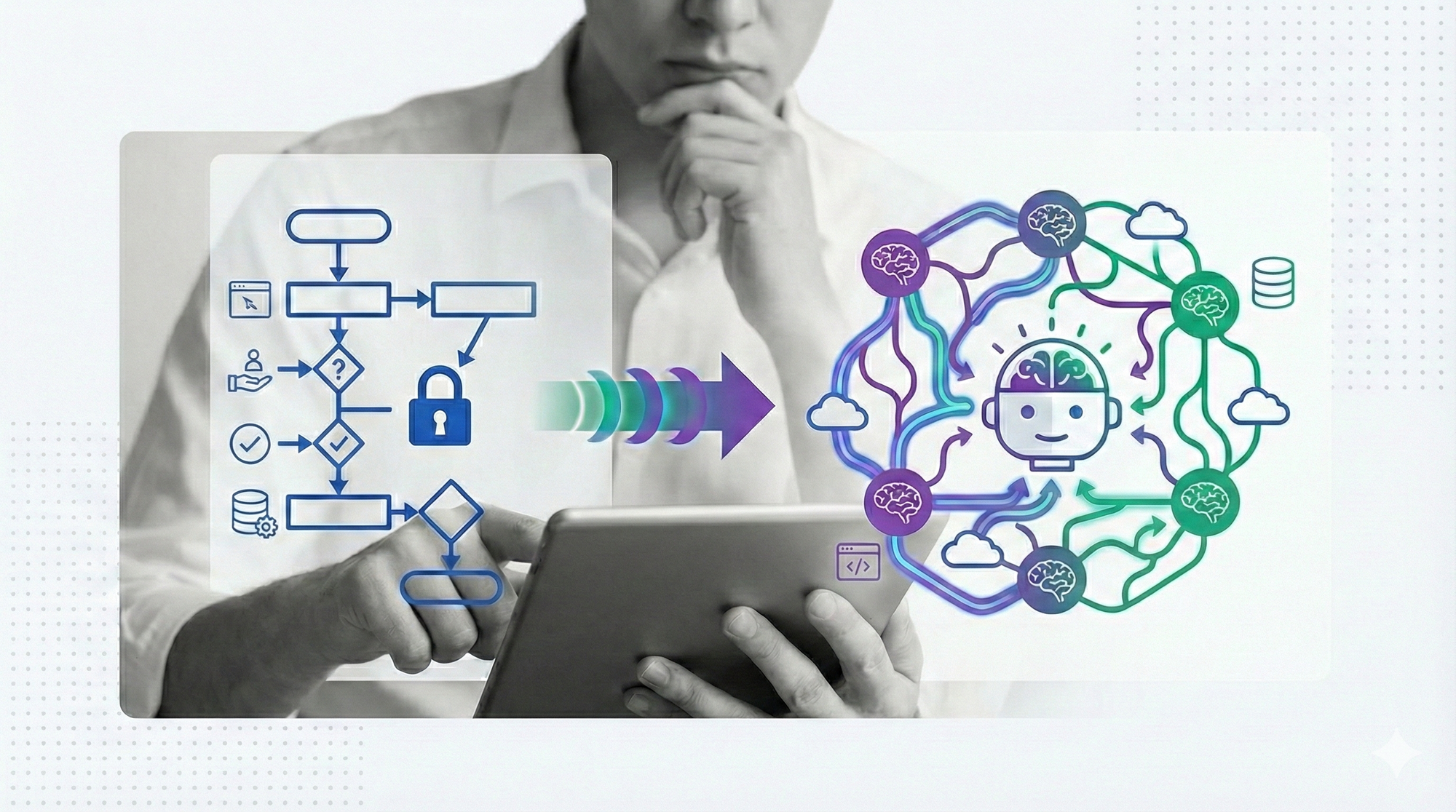
Workflow orchestration is moving from deterministic, rule-driven pipelines to agentic workflows that can reason under ambiguity while still being controlled by workflows. The platforms that win in 2026 will treat orchestration as the control plane, and treat reasoning as a bounded capability inside that plane. AI driven workflows will only scale when they ship with state, validation, and observability by default.
What workflow orchestration is, and what it is not
Workflow orchestration is the system that runs an end-to-end process, not just a sequence of tasks. It decides when work starts, what runs next, how dependencies are handled, how failures are recovered, and how humans are involved.
Workflow orchestration is not just scheduling. Scheduling starts jobs. Orchestration manages state across time, including retries, backoffs, partial completion, escalation, and audit trails.
If you want a quick test, ask this: when a step fails, does the system know what to do next without human guesswork. If yes, you have orchestration. If no, you have scripts and schedules.
What agentic workflows mean in production
Agentic workflows combine classic workflow orchestration with AI agents that can interpret context, choose tools, and decide which action to take next. The key word is inside. The agent should operate inside a workflow step with constraints, not outside the workflow as a free-running brain.
Agentic workflows are useful when rules alone do not cover the real world. They are also risky when teams let agents control execution without a control plane.
In practical terms, the future is not “replace workflows with agents.” The future is “use workflow orchestration to constrain agents.”
Why the future is moving from rules to reasoning systems
This shift is happening because the work itself has changed.
- Inputs are less structured
A lot of operational work starts in email, chat, documents, tickets, or messy CRM notes. Rule-driven automation struggles here. Reasoning helps interpret, normalize, and route. - Processes span more systems
Modern operations run across SaaS stacks, internal tools, and legacy systems. More systems means more failure modes. Orchestration is the only way to keep execution predictable. - Change is constant
UI changes, APIs evolve, policies change, org structure changes. Rule-only automations become brittle unless they are constantly maintained. Reasoning can absorb some variability, but only if the workflow still enforces boundaries. - Enterprises need explainability
As AI driven workflows touch customer ops, finance, and compliance, the requirement becomes “show your work.” Orchestration provides the skeleton for traceability. Reasoning fills in decisions, but decisions must be logged and validated.
The future of automation platforms
When people ask about the future of automation platforms, they often focus on who has the best model. That is usually the wrong question.
The platform differentiators in 2026 will be:
- Durable state and replayability
- Strong primitives for retries, escalation, and human review
- Permissioned tool calling and step-level tool scoping
- Observability that is process-native, not an afterthought
- Versioning for workflows, prompts, and tool contracts
- Evaluation loops that measure outcomes, not just uptime
Risks and failure modes when workflows become agentic
The shift to agentic workflows introduces new failure patterns that teams should expect.
Reasoning without boundaries
If the agent can decide everything, it will eventually decide something you did not intend. This is not a model problem. This is a system design problem.
Context overload and stale context
Agents often fail because they are fed too much context or outdated context. More context increases confusion and increases attack surface. Stale context creates confident wrong decisions.
Silent quality drift
AI driven workflows can “succeed” while producing lower quality outcomes over time. Without outcome monitoring, teams notice only when customers complain.
Tool misuse and permission creep
Tool calling turns a bad decision into a real-world change. If tool access is not scoped per step, you increase blast radius.
Unowned exceptions
When the workflow escalates, someone must respond. If ownership is unclear, the system stalls silently.
Guardrails and operating model that make agentic workflows safe
If you want agentic workflows to survive production, you need guardrails that do not rely on perfect prompts.
- Orchestration must be the control plane
The workflow should decide start, stop, retry, and escalation. The agent should propose and choose within that step. - Validate outputs before execution
Treat agent output as a suggestion. Validate against schemas, business rules, and invariants before calling tools that mutate systems. - Scope tools by step
Expose only the minimum set of tools for the current stage. Remove “global tool access.” Require approvals for high-risk tool calls. - Fail closed on uncertainty
If confidence is low, route to human-in-the-loop. If a validation check fails, do not proceed “just in case.” - Observe outcomes, not only runs
Track success rate, rework rate, escalation rate, cycle time, and customer impact metrics. Completion is not the same as correctness. - Version everything
Version workflow definitions, prompt templates, tool contracts, and policy rules. You need rollback as a normal operation, not an emergency.
How to implement AI driven workflows without chaos
Here is a simple playbook that teams can execute.
Step 1. Map the workflow in states, not steps
Define states like “received,” “classified,” “validated,” “approved,” “executed,” “completed,” “failed,” “needs review.” This makes failures and waiting normal.
Step 2. Choose where reasoning belongs
Add agentic workflows only where ambiguity exists. Do not add agents to deterministic steps that already work.
Step 3. Define tool contracts
For each tool, define input schema, output schema, permissions, rate limits, and failure behaviors.
Step 4. Add validation gates
Before any irreversible action, add checks. If checks fail, route to human review with full context.
Step 5. Build observability from day one
Log the state transitions, tool calls, agent decisions, and validation outcomes. Create dashboards that show bottlenecks and exception hotspots.
Step 6. Add evaluation loops
Sample outcomes, measure quality, and track drift. If an agent’s override rate increases, treat it like a regression.
Example workflow. From rules to reasoning in one process
Scenario: Customer operations, refund requests across email, CRM, and ERP.
Before, rules-only automation
A bot extracts a few fields from structured tickets, then updates systems. Anything outside the template fails, and operators manually fix the rest. Over time, backlog grows and trust drops.
After, workflow orchestration with agentic workflows
- Trigger: New email or ticket enters the queue.
- Agentic step: The agent classifies intent, extracts details, and suggests a decision path, including confidence and policy references.
- Validation gate: The workflow validates refund eligibility rules and checks for missing fields.
- Human-in-the-loop: If amount is above a threshold or confidence is low, route to approval with a structured summary.
- Execution: Use API integrations where available, and RPA where the ERP has no API surface.
- Monitoring: Record state transitions, decision reasons, and outcomes. Track override rates and exception rates.
What changes operationally
You get higher straight-through processing for low-risk cases, fewer silent failures, clearer ownership for exceptions, and a measurable path to improving decision quality over time.
FAQs
What is the future of workflow orchestration?
The future of workflow orchestration is durable, stateful orchestration that can host reasoning steps safely. The orchestration layer remains the control plane, while reasoning becomes a bounded capability used where rules are insufficient.
What are agentic workflows in simple terms?
Agentic workflows are workflows that include AI agent steps that can plan and decide next actions within limits. The workflow still governs state, retries, approvals, and stop conditions.
Are AI driven workflows replacing traditional automation?
AI driven workflows expand traditional automation, they do not replace it. Deterministic execution, retries, auditing, and governance remain necessary, and workflows are usually the foundation for that.
What changes when moving from rules to reasoning systems?
The main change is that decision logic becomes probabilistic, so you need validation gates, confidence thresholds, and human review paths. You also need monitoring for quality drift, not only runtime failures.
What are the biggest risks of agentic workflows?
The biggest risks are uncontrolled tool access, stale or overloaded context, and silent quality drift. Most of these risks are solved with workflow boundaries, validation, and observability.
What should teams prioritize when building agentic workflows in 2026?
Prioritize orchestration primitives first, like state, retries, and escalation. Then add reasoning only where ambiguity exists, and wrap it with validation, tool scoping, and outcome monitoring.
Conclusion
Workflow orchestration is evolving from rule execution to reasoning-enabled systems, but the control plane does not go away. Agentic workflows and AI driven workflows will only succeed when they are orchestrated, bounded, and observable. The future of automation platforms is not about replacing deterministic automation. It is about combining deterministic execution with bounded reasoning so organizations can run real processes every day without losing control.