The 2026 Guide to AI Agent Workflows: From Idea to Production
Anil Yarimca
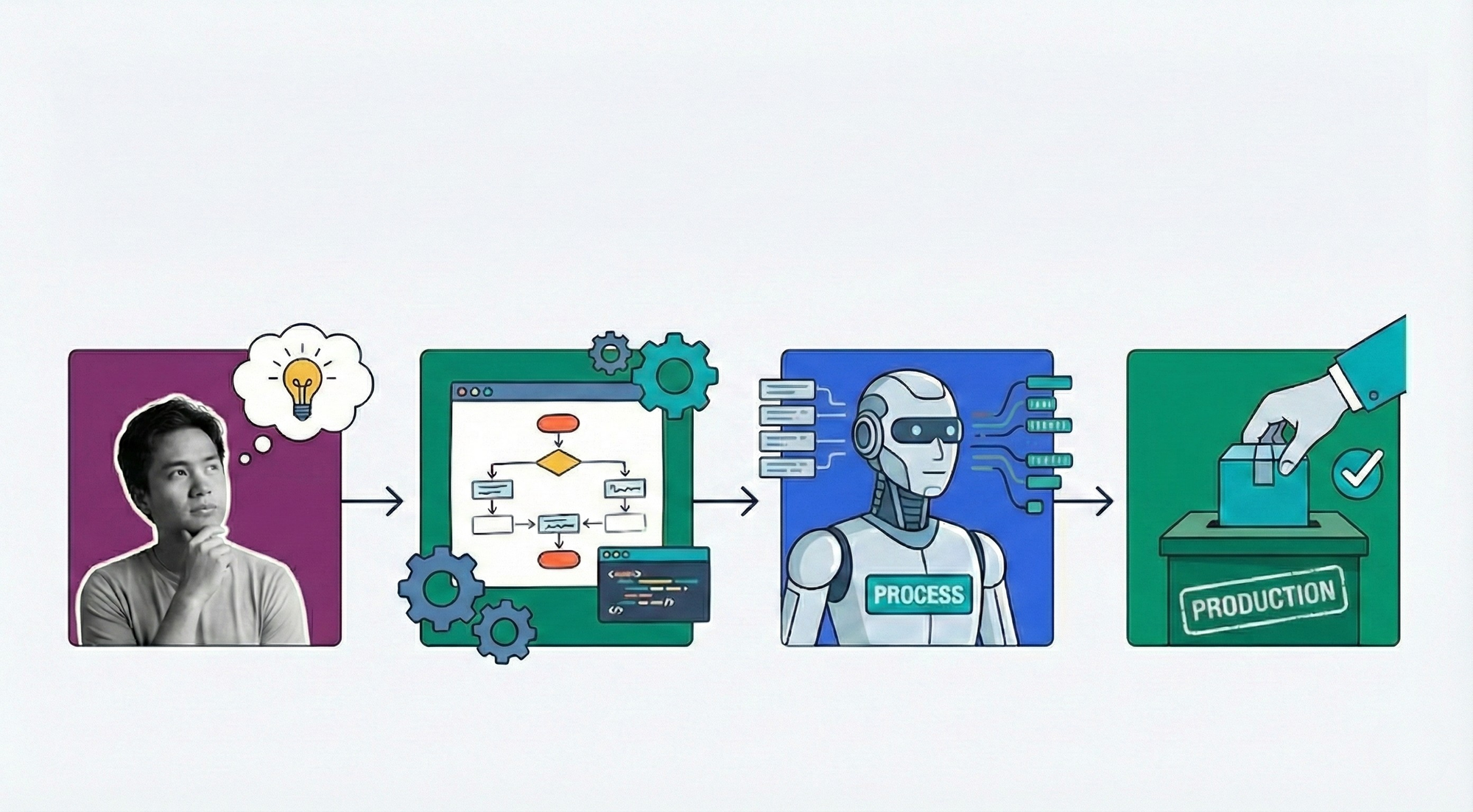
TL;DR
AI agent workflows are moving from experimental prompt chains to structured, production-grade systems. In 2026, successful teams design agent workflows with explicit planning, execution, refinement, and observability layers. This guide explains how agent workflows actually work in production and how to build them safely.
As AI agents move deeper into real business processes, the conversation is shifting away from individual prompts and toward workflows. Early agent experiments often rely on prompt chains or simple agent loops. These approaches work for demos, but they struggle once real data, real users, and real consequences are introduced.
In 2026, AI agent workflows are becoming the default way organizations operationalize AI agents. A workflow-first approach treats agents as participants in a system, not isolated sources of intelligence. This change reflects a broader lesson. Intelligence alone is not enough. Structure is what makes agents reliable.
This guide breaks down AI agent workflows end to end. It explains what they are, how they differ from prompt-based setups, how they evolve into production systems, and where teams most often fail when scaling.
What is an AI agent workflow
An AI agent workflow is a system that coordinates how AI agents plan, act, and respond over time. It defines when an agent runs, what context it receives, what actions it can take, and how results are handled.
Unlike simple prompt interactions, agent workflows are stateful. They span multiple steps, integrate with external systems, and include control logic beyond natural language reasoning.
In practice, an agent workflow looks more like a business process than a chat session. There are triggers, decision points, handoffs, and termination conditions.
How agent workflows differ from prompt-based interactions
Prompt-based interactions are reactive. A user provides input, the model generates output, and the interaction ends.
Agent workflows are proactive and persistent. They are triggered by events, scheduled jobs, or system state changes. They continue running until a defined outcome is reached.
Another key difference is accountability. Prompt-based systems optimize for response quality. Agent workflows optimize for process completion, correctness, and recoverability.
This is why workflows are necessary once agents move beyond assistance and into execution.
The core stages of an AI agent workflow
Most production-ready AI agent workflows follow a similar lifecycle, even if the implementation details differ.
Planning
Planning is where the agent determines what needs to be done and in what order. This can include task decomposition, prioritization, and selection of tools or sub-agents.
In early prototypes, planning often happens implicitly inside a prompt. In production systems, planning is usually constrained by rules, schemas, or predefined steps to reduce unpredictability.
A common mistake is letting planning remain fully open-ended. This makes workflows fragile and difficult to debug.
Execution
Execution is where the agent performs actions. This includes calling APIs, reading files, updating records, or triggering downstream systems.
Execution steps must assume failure as a normal condition. Network issues, partial responses, and invalid data are expected in real environments.
Production workflows separate execution logic from reasoning. The agent decides what to do, but the workflow controls how actions are carried out and retried.
Refinement
Refinement is the process of improving outputs based on feedback, validation, or downstream results. This may involve re-running steps, correcting errors, or escalating cases to humans.
In prompt-based setups, refinement is manual. In workflows, it is systematic. Validation rules, confidence thresholds, and review steps determine whether results are accepted.
Teams often skip refinement in early designs, which leads to silent quality degradation at scale.
Observability and monitoring
Observability answers a critical question. What happened, and why.
Agent workflows must expose state, decisions, errors, and performance metrics. Without this visibility, teams cannot trust or improve the system.
Monitoring includes latency, cost, error rates, decision consistency, and tool failures. It also includes qualitative review of edge cases.
In 2026, observability is no longer optional for agent workflows. It is a prerequisite for governance.
How agent workflows evolve from prototype to production
Most teams start with a prototype that works under ideal conditions. The transition to production exposes gaps.
The first change is explicit state management. Production workflows track progress, retries, and partial completion instead of relying on implicit memory.
The second change is error handling. Every step gains fallback paths, timeouts, and escalation rules.
The third change is versioning. Models, prompts, tools, and context are versioned independently so changes can be rolled back safely.
Teams that do not redesign workflows during this transition often experience the same outcome. The demo works. Production fails.
Common mistakes when scaling AI agent workflows
One common mistake is overloading agents with responsibility. When a single agent plans, executes, validates, and escalates, failures become hard to isolate.
Another mistake is relying on natural language alone for control flow. Language models are good at reasoning, but they are not deterministic controllers.
Lack of observability is another frequent issue. Without logs and state inspection, teams debug symptoms instead of root causes.
Finally, many teams underestimate coordination. As workflows grow, agents must interact through structured handoffs rather than ad hoc messaging.
Real-world examples of agent workflows
In document processing, workflows typically include ingestion, classification, extraction, validation, and posting. Each step may involve a different agent or rule set.
In customer operations, workflows route requests, resolve standard cases, and escalate exceptions with full context.
In internal reporting, workflows collect data, check consistency, generate narratives, and distribute outputs on a schedule.
In each case, the workflow defines reliability. The agent provides intelligence within those boundaries.
Why workflow-centric platforms matter
Building agent workflows from scratch is possible, but it is rarely efficient.
Workflow-centric platforms provide orchestration, state management, logging, retries, and integrations out of the box. Agents become steps inside workflows rather than standalone systems.
Platforms like Robomotion help teams structure agent workflows explicitly. Planning, execution, and refinement are visible. Errors are handled systematically. Context is passed in controlled ways.
This does not eliminate complexity. It makes it inspectable and manageable.
FAQs
What is an AI agent workflow?
An AI agent workflow is a structured system that coordinates how AI agents plan actions, execute tasks, and handle results across multiple steps. It is designed for process completion, not just single responses.
How is an agent workflow different from an AI agent?
An AI agent is a component that reasons and acts. An agent workflow is the system that defines when the agent runs, what context it receives, and how its outputs are handled.
Do AI agent workflows require multiple agents?
Not always. A workflow can involve a single agent or many agents. The defining feature is structured execution, not agent count.
What breaks most often when workflows scale?
Lack of error handling, missing observability, and unclear ownership between steps are the most common failure points.
Are prompt chains considered agent workflows?
Prompt chains are an early form of workflows, but they lack state management, error handling, and observability. They rarely survive production unchanged.
How do you monitor AI agent workflows?
By tracking state transitions, errors, latency, cost, and decision outcomes at each step. Logs and metrics are essential.
Why is observability critical for agent workflows?
Without observability, teams cannot explain decisions, debug failures, or improve performance over time. Trust depends on visibility.
Where does Robomotion fit in AI agent workflows?
Robomotion provides orchestration, integration, and control layers that help teams operationalize AI agent workflows safely and consistently.
Conclusion
In 2026, AI agent workflows are becoming the foundation of production AI systems. The shift from prompts to workflows reflects a deeper understanding. Intelligence needs structure to be useful.
Teams that invest in planning, execution control, refinement, and observability build systems that scale. Teams that do not remain stuck in prototypes.
Agent workflows are not about making agents smarter. They are about making AI reliable in the real world.