No-Code, Low-Code, or Agentic Automation? Choosing the Right Level of Abstraction
Anil Yarimca
TL;DR
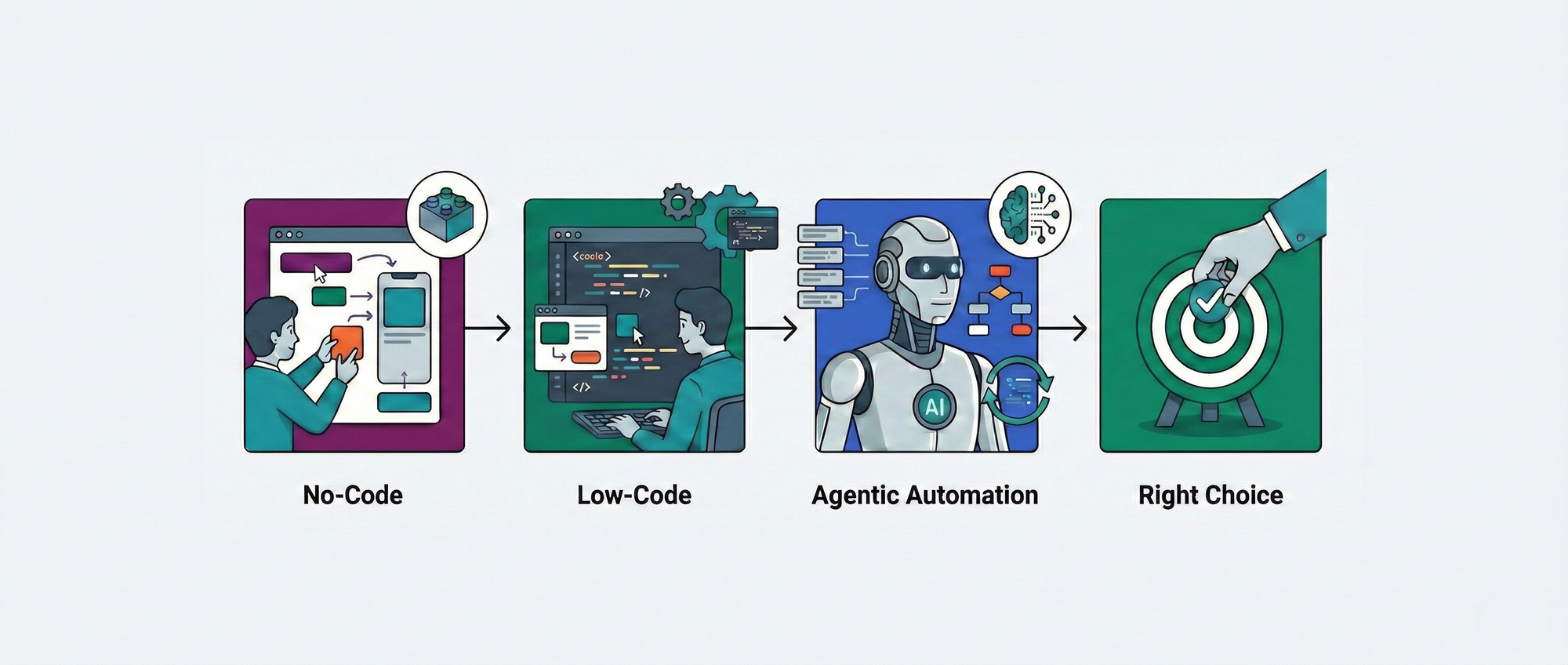
The real decision in automation is not no-code versus low-code. It is choosing the right level of abstraction for the problem you are solving. Teams run into fragile systems when the abstraction level does not match the complexity of the work. This guide explains no-code, low-code, and agentic automation, how they differ, and how to choose correctly.
For years, automation discussions have been framed as no-code versus low-code. No-code promises speed and accessibility. Low-code promises flexibility and control. In practice, many teams adopt one approach too broadly and then struggle when systems grow.
What often goes wrong is not the tool itself. It is an abstraction mismatch. Simple problems get over-engineered. Complex problems get oversimplified. The result is systems that look productive early and become fragile later.
More recently, agentic automation has entered the conversation. It introduces a different abstraction layer entirely, one focused on intent, decision-making, and adaptability rather than static logic.
To choose correctly, teams need to think less about labels and more about abstraction levels.
What abstraction level actually means
An abstraction level defines how much of the underlying complexity is hidden and who is expected to handle it.
Higher abstraction hides complexity and accelerates delivery, but limits flexibility. Lower abstraction exposes complexity and increases control, but requires more expertise and maintenance.
No-code, low-code, and agentic automation are not competitors. They are different abstraction layers designed for different types of work.
No-code automation
No-code automation focuses on accessibility. Users build workflows using visual builders, predefined actions, and templates.
This approach works best when processes are stable, well-defined, and repetitive. Examples include simple approvals, data synchronization, and basic integrations.
The advantage of no-code is speed. Teams can move quickly without engineering resources. The downside appears when logic grows. Edge cases accumulate. Visual flows become hard to reason about.
A common mistake is using no-code for processes that require frequent change or complex branching. Over time, maintenance becomes harder than writing code would have been.
Low-code automation
Low-code automation exposes more control while still providing structure. Users can combine visual workflows with scripts, expressions, or custom components.
This level is well suited for processes with conditional logic, system integration, and moderate complexity. Many enterprise operations sit here, such as order processing, compliance checks, and internal tooling.
Low-code offers flexibility, but it also introduces responsibility. Someone must understand both the business process and the technical behavior.
Teams often fail when low-code systems grow without clear ownership. What starts as a shortcut becomes a mini software project without software discipline.
Agentic automation
Agentic automation represents a different abstraction layer. Instead of defining every step explicitly, teams define goals, constraints, and allowed actions. AI agents decide how to act within those boundaries.
This approach is powerful for processes that involve ambiguity, judgment, or dynamic inputs. Examples include document understanding, customer operations, and exception handling.
Agentic automation does not remove the need for structure. It shifts structure from fixed logic to controlled decision spaces. Without guardrails, agentic systems become unpredictable.
This distinction is discussed in depth in recent writing on agent workflows and agent orchestration, including OpenAI’s guidance on building reliable agent systems and LangChain’s work on agent architectures. These sources highlight that agentic systems require stronger control layers, not fewer.
Trade-offs between abstraction levels
Speed favors higher abstraction. No-code and agentic approaches allow faster iteration early on.
Flexibility favors lower abstraction. Low-code and code-heavy approaches adapt better to edge cases.
Maintenance favors clarity. Systems that match abstraction to problem complexity are easier to maintain than systems stretched beyond their design.
Agentic automation adds a new trade-off. It reduces the need to encode logic upfront but increases the need for monitoring, evaluation, and governance.
How abstraction mismatch creates fragile systems
Fragility often comes from choosing the wrong abstraction.
Using no-code for complex logic leads to brittle visual workflows. Small changes cause unintended side effects.
Using low-code where no-code would suffice leads to unnecessary technical debt and slower iteration.
Using agentic automation without guardrails leads to systems that behave differently under similar conditions.
In each case, the issue is not capability. It is misalignment between problem shape and abstraction level.
Research and practitioner experience show that many production failures blamed on AI are actually workflow and abstraction failures. This is echoed in broader automation discussions from organizations like Gartner and McKinsey, which emphasize matching automation approaches to process complexity rather than technology trends.
A decision framework for choosing the right level
Before selecting tools, teams should answer a few questions.
How stable is the process?
If it rarely changes, higher abstraction is safer.
How many edge cases exist?
More edge cases push toward lower abstraction or agentic approaches with guardrails.
How critical is explainability?
Regulated or high-risk processes require more explicit control.
Who will maintain the system?
Business teams favor no-code. Technical teams can sustain low-code or agentic systems.
Does the process require judgment?
If yes, agentic automation may be appropriate.
This framework helps avoid defaulting to a single approach for everything.
Moving from one abstraction level to another
Most teams evolve over time. They start with no-code to validate value. They move to low-code as complexity grows. They introduce agentic automation where rigid logic breaks down.
Problems arise when teams treat these levels as mutually exclusive. In reality, mature systems mix them.
A single workflow may include no-code steps for routing, low-code logic for validation, and agentic components for interpretation.
How platforms support multiple abstraction levels
This is where platform choice matters.
Platforms that force a single abstraction level limit how systems can evolve. Teams either outgrow the tool or misuse it.
Platforms like Robomotion are designed to support multiple abstraction levels in one environment. Visual workflows coexist with scripting and agent-based decision steps. Orchestration, logging, and governance remain consistent across approaches.
This allows teams to choose the right abstraction per step rather than per platform.
External perspective on abstraction in automation
The idea of choosing abstraction levels is not unique to AI. It appears in classic software engineering discussions about frameworks versus libraries, and in modern automation strategy.
For example, Martin Fowler’s writing on abstraction and complexity management highlights how the wrong abstraction creates accidental complexity. Similarly, recent analyses of AI agents in production emphasize that higher-level automation requires stronger system design, not less.
These perspectives reinforce the same lesson. Abstraction is a design decision, not a shortcut.
FAQs
What is the main difference between no-code and low-code automation?
No-code hides complexity and prioritizes speed. Low-code exposes more control and flexibility but requires more technical understanding.
Is agentic automation a replacement for no-code or low-code?
No. Agentic automation is a different abstraction level designed for judgment-based and dynamic processes. It complements other approaches.
When should teams avoid no-code automation?
Teams should avoid no-code when processes have complex branching, frequent changes, or strict governance requirements.
What risks come with agentic automation?
The main risks are unpredictability and lack of control if guardrails, monitoring, and evaluation are missing.
Can one workflow use multiple abstraction levels?
Yes. Mature systems often combine no-code, low-code, and agentic steps within the same workflow.
How do abstraction mismatches show up in production?
They show up as brittle logic, unexpected failures, high maintenance cost, and difficulty explaining system behavior.
Why do enterprise teams care about abstraction levels?
Because abstraction choices affect scalability, compliance, and long-term operational cost.
Conclusion
Choosing between no-code, low-code, and agentic automation is really about choosing the right level of abstraction.
Teams that match abstraction to problem complexity build systems that scale and remain maintainable. Teams that chase speed or novelty without this alignment create fragile systems.
The future of automation is not one approach winning. It is platforms and teams that can operate across abstraction levels intentionally and safely.