Context Engineering for AI Agents: Why Prompts Alone Are Not Enough
Anil Yarimca
TL;DR
Prompt engineering is effective for shaping how an agent responds in a single interaction, but it breaks down in production when memory, state, and external data access are required. Context engineering for AI agents addresses this by designing structured context layers such as files, logs, rules, and historical outputs that make decisions consistent and traceable. This article explains what context engineering is, why it matters now, common failure modes, and a practical playbook.
Context engineering for AI agents has gained attention because prompt engineering reaches its limits in real systems. A prompt can influence how an agent responds in the moment, but it does not reliably control what the agent knows, remembers, or references across time. In production environments, AI agents interact with file systems, APIs, workflows, and past decisions. These interactions require more than carefully written instructions.
Prompt engineering is not going away, but its role is changing. As AI agents move from chat interfaces into automated workflows, the main challenge is no longer phrasing instructions. It is designing the context the agent operates in. For technical and semi-technical teams, the goal is predictable, auditable behavior rather than impressive one-off outputs.
Prompt engineering is the practice of writing instructions and examples inside a single input to guide an AI model’s behavior for a specific task or response.
What context engineering is, and what it is not
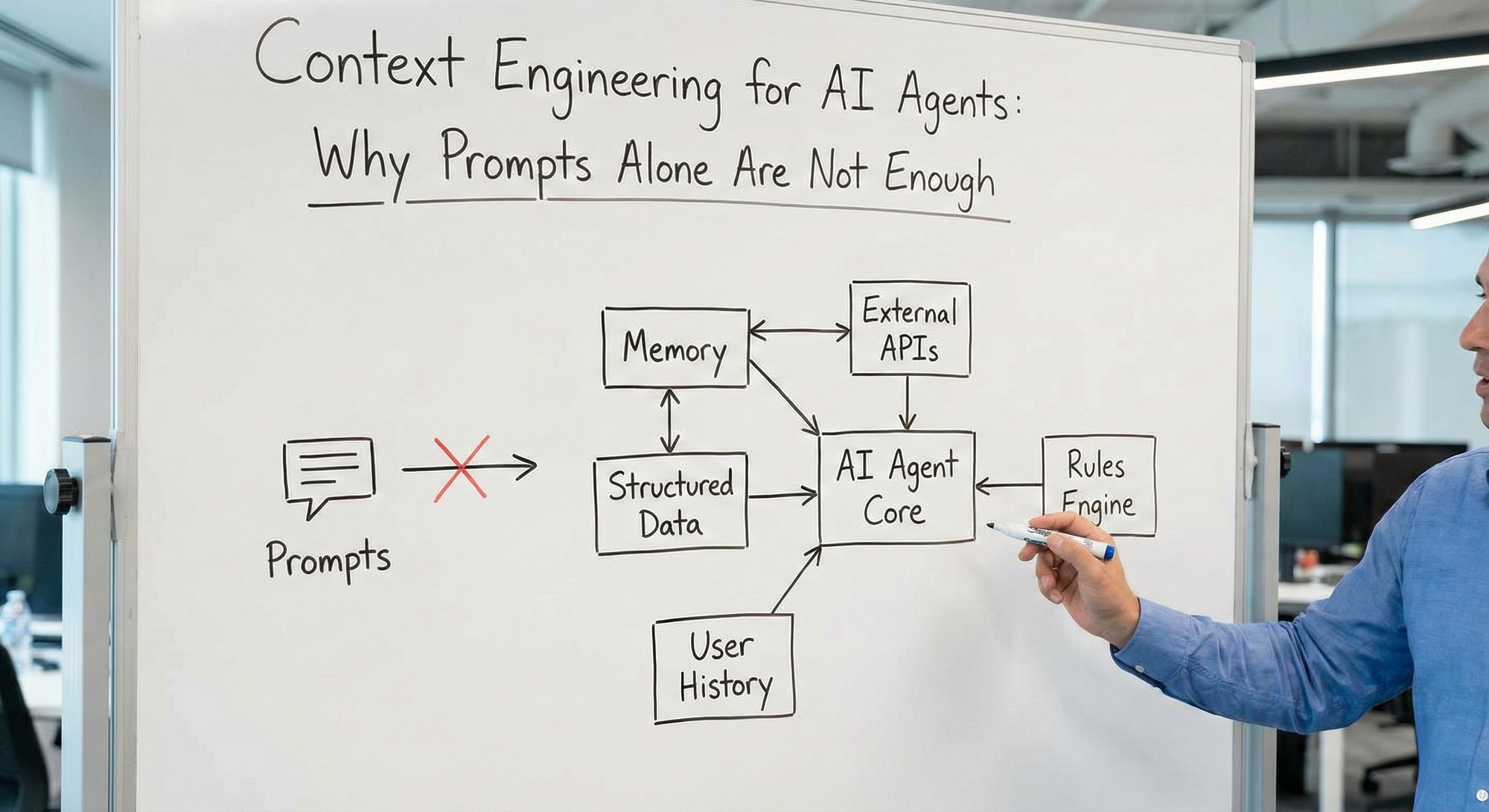
Context engineering is about controlling the agent’s environment. It defines what data the agent can access, how that data is structured, and how long it remains valid. This includes memory stores, file systems, databases, logs, and explicit business rules.
Context engineering is not about writing longer prompts. Adding more instructions to a prompt does not create memory. It does not create state. It does not guarantee data freshness or relevance. Prompt engineering optimizes a single interaction. Context engineering designs a system.
Another key difference is determinism. Prompts are interpreted probabilistically. Context layers can be constrained, validated, and versioned. This makes them far more suitable for production AI systems where behavior must be explainable.
Why context engineering for AI agents matters now
AI agents are increasingly embedded in real business processes. They classify tickets, reconcile data, generate reports, and trigger downstream actions. These tasks require continuity across steps and awareness of previous outcomes.
In enterprise settings, teams care about repeatability, governance, and auditability. Context engineering supports all three. By externalizing knowledge into structured sources, teams can inspect what an agent knew at the moment a decision was made.
This also changes how success is measured. The question is no longer whether the agent answered correctly once. It becomes whether the agent produces consistent decisions under the same conditions and degrades safely in edge cases.
Quick answer: Why are prompts not enough for AI agents in production?
Prompts only influence a single interaction. Production agents need memory, access to external data, and structured state to behave consistently across workflows. Context engineering provides this structure and enables governance.
Risks and failure modes
Context engineering fails in predictable ways if it is not designed carefully.
The most common issue is context overload. Giving an agent too much information reduces signal quality, increases latency, and often degrades output quality. More context does not automatically lead to better decisions.
Another failure mode is stale context. If files, summaries, or memory are not refreshed, the agent makes decisions based on outdated assumptions. In automated workflows, these errors can propagate quickly.
A third risk is hidden coupling. When context sources are implicit or poorly documented, upstream changes silently alter agent behavior. Teams then debug symptoms instead of root causes.
Quick answer: What is context overload in AI agents?
Context overload occurs when an agent receives more information than it can effectively use. This increases cost and latency while reducing decision quality.
Quick answer: Why does stale context cause production incidents?
Stale context causes an agent to behave correctly according to old information. In automated systems, this can spread incorrect decisions before anyone notices.
Practical guardrails and operating model
If context engineering is going to work in production, context must be treated like a product surface.
Start with strict scope control. An agent should only see the context required for the current task. Task-specific context slices are safer and more effective than a single global memory.
Version context assets. Context schemas, summaries, and rule files should be versioned like code. This makes behavioral changes traceable.
Make context observable. Every run should log which files, records, memories, and external sources were accessed. This is essential for debugging and governance.
Agent memory is a structured mechanism that stores selected past interactions or decisions and makes them retrievable later in a controlled way.
How to implement context engineering for AI agents
The following playbook focuses on production realities rather than demos.
Step 1: Identify decision points
Map where the agent makes decisions that affect outcomes. Approvals, routing, enrichment, and exception handling are common examples.
Step 2: Classify context types
Keep context separated into clear categories.
Static rules include policies, constraints, and business logic.
Dynamic data includes customer records, ticket details, inventory status, and pricing.
Historical memory includes past decisions, prior outputs, and resolved edge cases.
Step 3: Design retrieval logic
Define when and how context is loaded. Avoid loading everything by default. Load the smallest amount of context needed to make the next decision well.
Step 4: Add freshness checks
Attach timestamps and validity rules. For example, reload pricing data after a defined interval and always fetch the latest policy version.
Step 5: Instrument and log usage
Log which context elements are used in each run. Without this, reliable debugging is not possible.
Step 6: Iterate based on outcomes
Analyze failures and update context design. Repeated edge cases usually indicate missing or poorly structured context.
Example workflow: Files, logs, and historical context
Consider a refund approval agent.
Before context engineering, the agent relies on a natural language prompt describing refund policy. It performs well in tests but occasionally approves invalid refunds in production.
After context engineering, refund rules are stored in structured files. Past decisions are logged with reasons and outcomes. The agent retrieves the relevant policy section and similar historical cases before deciding. Decisions are written back as structured records.
The results are measurable. Policy violations decrease. Decision consistency improves. Audits become straightforward because every decision can be traced to specific context elements.
This is why workflow-based platforms matter. When AI agents operate inside automated workflows, structured context like files, logs, and system state becomes a first-class input.
FAQs
What is the difference between prompt engineering and context engineering for AI agents?
Prompt engineering focuses on instructions inside a single input. Context engineering manages external knowledge, memory, and state across interactions.
Does context engineering replace prompt engineering?
No. Prompt engineering still matters for framing tasks and outputs. Context engineering handles what the agent knows and accesses.
Do AI agents need memory to work correctly?
Agents operating across multiple steps benefit from memory to maintain consistency and avoid repeating mistakes.
How do AI agents use files as context?
They read structured files such as policies, schemas, catalogs, or reports to ground decisions in explicit data.
What are common mistakes in context engineering?
Common mistakes include loading too much context, failing to refresh it, and not logging context usage.
Is context engineering required for autonomous agents?
Autonomous agents depend heavily on context because they operate without constant supervision.
Conclusion
Context engineering for AI agents represents a shift from instruction-centric design to system-centric design. Prompts still matter, but they are no longer the primary lever for reliability in production. Structured context, observable memory, and controlled data access are what make AI agents trustworthy over time.