Agentic Automation vs RPA: Why This Is Not a Replacement Story
Anil Yarimca
TL;DR
Agentic automation expands what automation can handle by adding goal-driven decision-making, but it does not replace RPA’s execution strength. In production, the winning pattern is intelligent process automation, where agentic steps live inside orchestrated workflows and RPA handles deterministic work. If you treat this as a replacement story, you usually end up with either brittle bots or unpredictable agents.
What agentic automation is, and what it is not
Agentic automation is automation where an AI agent can plan, choose tools, and decide what to do next based on context and outcomes. The agent is not just generating text. It is making bounded decisions that move a workflow forward.
Agentic automation is not “fully autonomous AI that replaces process design.” In production, agents work best when their autonomy is constrained by explicit rules, tool permissions, state, and stop conditions. OpenAI’s practical guide frames agents as systems built from models, tools, and orchestration, not prompts alone.
What RPA is, and what it is not
RPA is a way to automate structured, repeatable steps by mimicking how humans use software. It is strongest when the process is deterministic, the systems are known, and you need reliable execution at volume.
RPA is not “smart” by default. It does not interpret ambiguous inputs well, and it can become brittle if you use UI automation where APIs or stable integrations would be better. In production RPA, resilience comes from patterns like queues, transactions, retries, and item-level tracking, which are well-documented in vendor guidance.
Agentic automation vs RPA
The fastest way to see why this is not a replacement story is to compare what each approach is responsible for.
RPA is responsible for execution.
It is best at doing the same thing correctly many times, even when the UI is the only integration surface.
Agentic automation is responsible for decisions under ambiguity.
It is best at interpreting messy inputs, choosing among options, and handling cases where you cannot realistically encode every branch up front.
If you try to make RPA “think,” you overfit rules and collapse under edge cases.
If you try to make agents “execute everything,” you lose determinism, auditability, and repeatability.
In production, you want both, and you want clear boundaries between them.
How intelligent process automation connects the two
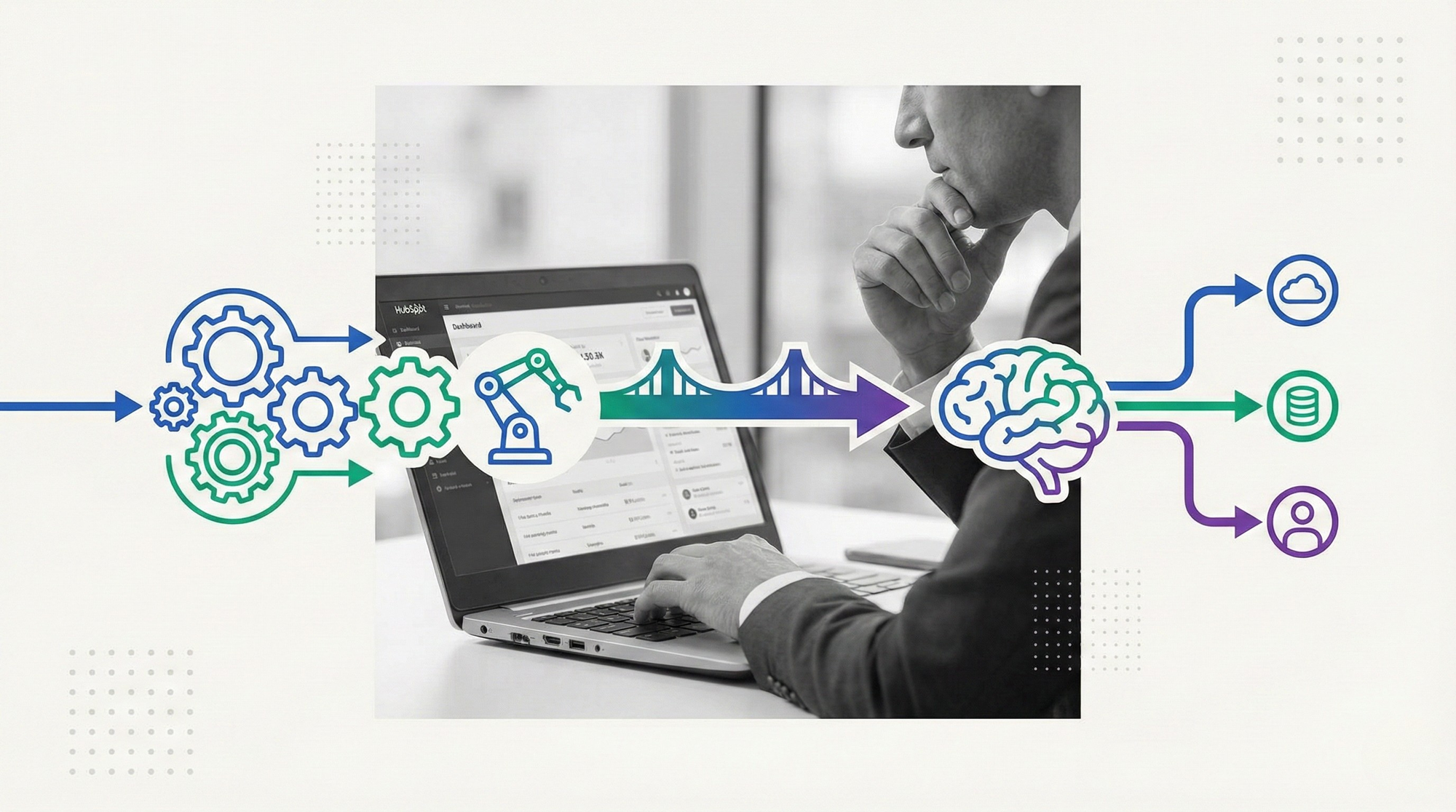
Intelligent process automation, sometimes called intelligent automation, is the system pattern that combines AI capabilities with automation execution so processes can handle both ambiguity and scale.
In a practical architecture:
- Agentic automation handles interpretation and decision support.
- RPA and integrations handle deterministic actions.
- Workflow orchestration coordinates the end-to-end process, including retries, escalations, and approvals.
This is the point most teams miss. The “intelligence” should not replace the workflow. The intelligence should operate inside it.
Why this is not a replacement story
Replacing RPA with agents sounds appealing until you hit production constraints.
- Determinism still matters
Most business processes have steps that must be executed exactly, with strict validation and predictable results. That is RPA’s strength. - Audit trails and accountability matter more than cleverness
Agents can be hard to explain without structure. Regulated and customer-facing processes require traceability. - Failure recovery is the real work
In production, systems time out, credentials expire, and data is incomplete. You need retries, fallbacks, and escalation paths. Agents alone do not give you that operating model. - Permissions and blast radius must be controlled
As soon as an agent can call tools that mutate systems, risk increases. You need strict guardrails, approvals, and monitoring.
A useful mental model is: agents change how you decide. RPA changes how you execute.
Risks and failure modes
If you are building intelligent process automation that includes agentic automation and RPA, these are the failure modes that show up most often.
Context overload
Agents become slower and less reliable when they are fed uncurated context. More context is not always better.
Stale context and hallucinated certainty
If the agent relies on outdated files, logs, or business rules, it can make confident, wrong decisions. This is one reason governance and risk management frameworks matter. NIST’s AI Risk Management Framework materials are a good reference point for thinking about risks, controls, and monitoring in real deployments.
UI fragility and silent breakage
RPA can fail when selectors change or pages load differently, especially without good exception handling and monitoring.
Unowned exceptions
If it is unclear who handles failed queue items, low-confidence agent outputs, or stuck workflow states, the system will degrade silently.
Practical guardrails that make the combination work
Here is a production-grade set of guardrails that keeps agentic automation and RPA aligned.
- Use workflow orchestration as the control plane
Agents should not “run the process.” They should be a step in the process. The workflow defines start, stop, retries, and escalation. - Constrain tool calling by step
Expose only the tools needed for the current workflow step. Avoid “global tool access.” - Add confidence gates and validation
Before an agent output triggers an irreversible action, validate it. Use schema checks, business rules, and in some cases a second-pass verification step. - Isolate failures at the item level
For transactional work, use queue item patterns so one failure does not block the whole run. Vendor queue and transaction concepts are designed for this. - Require approvals for high-risk actions
Human-in-the-loop is not a compromise. It is a reliability strategy for high-impact steps.
How to choose the right approach
Use RPA when:
- The work is repetitive, structured, and high volume
- UI automation is necessary because APIs are missing
- Determinism and throughput matter more than interpretation
Use agentic automation when:
- Inputs are unstructured or inconsistent (emails, docs, chat)
- The right path depends on context and can vary case by case
- You need flexible decisioning within boundaries
Use intelligent process automation when:
- The process requires both interpretation and execution
- You need end-to-end operability, monitoring, and governance
- You want systems that can evolve from prototype to production without rewrites
Measurement
If you cannot measure it, you cannot operate it. For this combined approach, measure:
Outcome metrics
Completion rate, error rate, rework rate, cycle time, cost per case
Reliability metrics
Retry rates, escalation rates, queue backlog age, step-level failure hotspots
Decision quality metrics
Human override rate, validation failure rate, confidence distribution drift over time
Example workflow
Scenario: Customer refund processing across email, CRM, and ERP.
Before
A support rep reads an email, decides if it qualifies, then manually updates CRM and ERP. Errors happen when details are missing or policy rules are misread.
After, with intelligent process automation
Step 1: Agentic automation classifies intent and extracts key fields from the email, then checks policy rules in a structured context store.
Step 2: If confidence is low or the refund amount is above a threshold, the workflow routes to human approval.
Step 3: Once approved, RPA updates the ERP where API access is limited, and an integration updates the CRM.
Step 4: The workflow logs outcomes, captures exceptions, retries transient errors, and records an audit trail.
What improves measurably
Higher straight-through processing rate for low-risk cases, lower manual handling time, clearer exception ownership, and fewer silent failures.
FAQs
Agentic automation vs RPA, which is better?
Neither is universally better. Agentic automation is better for ambiguous, variable work. RPA is better for deterministic execution at scale. Most production systems need both.
Is agentic automation replacing RPA?
No. Agentic automation is changing how decisions are made, not eliminating the need for reliable execution. In production, agentic steps usually sit inside orchestrated workflows that still use RPA where needed.
Is this basically RPA 2.0 with AI?
“RPA 2.0 with AI” is a reasonable shorthand if it means intelligent process automation, where AI handles interpretation and RPA handles execution under orchestration. It is misleading if it implies you can bolt AI onto bots without redesigning workflows, monitoring, and governance.
When should I avoid agentic automation?
Avoid it for high-risk actions without strong guardrails, for processes that require strict determinism, or when you cannot provide curated context and clear tool permissions.
What is the biggest risk when combining agents with RPA?
The biggest risk is uncontrolled behavior, either from agents calling powerful tools without validation, or from RPA silently failing due to brittle UI automation. The fix is orchestration, validation, and monitoring.
What is the safest architecture pattern?
Use workflow orchestration as the backbone. Add agents as bounded decision steps. Use RPA and APIs for execution. Add item-level retries, approvals for high-risk actions, and end-to-end monitoring.
Conclusion
Agentic automation and RPA solve different problems, so the real story is composition, not replacement. Agentic automation helps systems handle ambiguity and decisioning. RPA helps systems execute reliably across real-world enterprise software. Intelligent process automation combines both inside orchestrated workflows, with guardrails, monitoring, and clear ownership, which is the difference between a compelling demo and a system that survives production.